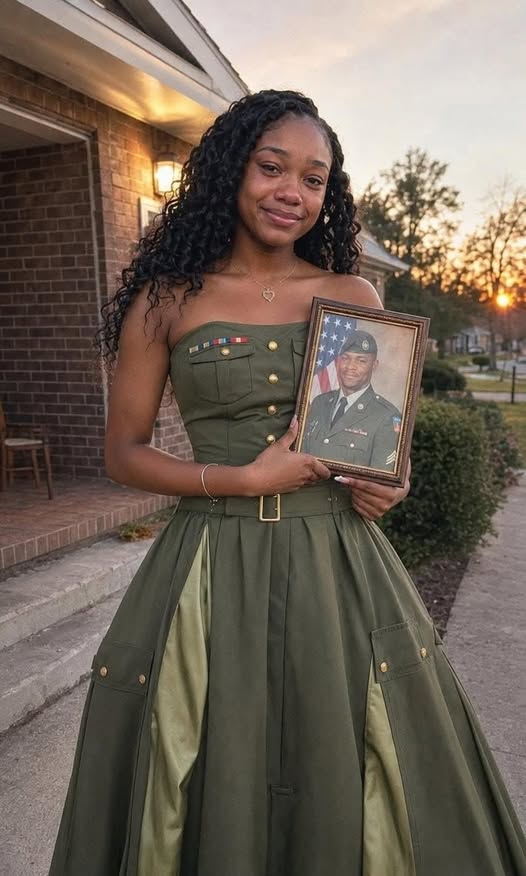
I walked into prom wearing a dress sewn from my dead father’s old army uniform—and the entire room went silent before the laughter started.
Not the kind of laughter that bursts out with joy.
The cruel kind. The sharp kind. The kind that cuts deeper when it comes from people who already know where to aim.
My stepmother stood near the refreshment table with a glass of sparkling cider in hand, her lips curling slowly as her eyes dragged over every inch of the dress. My two stepsisters hovered beside her like shadows, dressed in glittering gowns bought with money my father had once worked himself nearly to death to provide.
“Well,” one of them whispered loudly enough for everyone nearby to hear, “I guess military surplus is trending now.”
The other snorted into her drink.
I felt every stare in the gymnasium burn against my skin.
Some people looked uncomfortable.
Some looked entertained.
Most looked away.
But I kept walking.
Because they didn’t understand what the dress really was.
The fabric wasn’t just fabric.
Those faded green panels had once rested against my father’s shoulders while he served overseas. The stitched pockets, the carefully pressed sleeves, the tiny frayed edges near the seams—they carried pieces of him. Memories. Sacrifice. Love.
I had spent weeks making the dress alone in my bedroom with an old sewing machine and trembling hands. Every stitch felt like a conversation with him. Every thread held together parts of me that grief had tried to unravel.
And tonight, I wore him with pride.
Still, humiliation crawled hot across my face as whispers followed me through the crowd.
“Did she seriously make that herself?”
“She looks ridiculous.”
“Honestly, it’s kind of pathetic.”
My stepmother’s voice sliced through them all.
“Your father would’ve wanted you to move on,” she said coldly. “Not turn yourself into a spectacle.”
The words hit harder than I expected.
Because after my father died three years earlier, “moving on” was exactly what they had done.
His photographs disappeared first.
Then his books.
Then the stories about him stopped altogether, like he had never existed inside those walls.
But I remembered.
I remembered the smell of boot polish and coffee in the mornings.
I remembered the way he saluted me jokingly before school.
I remembered how he used to say, “No matter what happens, kiddo, stand tall.”
So I stood tall.
Even when my throat burned.
Even when my eyes threatened to betray me.
Then came the knock at the door.
Sharp. Firm. Unexpected.
The music inside the gym faded awkwardly as heads turned toward the entrance.
A man in full military uniform stepped inside.
Tall. Serious. Decorated.
Immediately, the laughter died.
My stepmother blinked in confusion, forcing a polite smile as she approached him. “Can I help you?”
The officer barely looked at her.
Instead, his eyes searched the room until they landed on me.
And when he spoke, his voice carried a level of respect I hadn’t heard directed at me in years.
“Miss Evelyn Carter?”
The sound of my full name froze me in place.
Not “Evy.”
Not “girl.”
Not the dismissive nicknames my stepfamily tossed around carelessly.
My real name.
The way my father used to say it whenever he was proud of me.
I swallowed hard and stepped forward.
“Yes?”
The officer reached into a leather folder and handed me a thick envelope.
“This was scheduled to be delivered on your eighteenth birthday,” he said gently. “Your father instructed us personally.”
Suddenly the room felt too small.
Too quiet.
I could hear the rustle of paper as my shaking fingers opened the envelope.
Inside were documents. Official forms. Letters.
And my father’s signature.
Everywhere.
My vision blurred as I read.
Scholarship approval papers from a private university across the country.
A housing deed to a small apartment already paid for under my name.
A savings account my father had secretly built over years of service.
And finally, a handwritten letter.
My dearest Evelyn,
If you are reading this, then I am no longer there to protect you myself.
But I need you to know something: I saw your strength long before you ever did.
I know this house may become heavy with silence after I’m gone. I know some people may try to make you feel small. Do not let them.
You come from fighters.
This money, this home, this future—it belongs to you. Not because you earned my love, but because you never had to.
Live bravely.
Live freely.
And when the world tries to shame you for carrying my memory, carry it anyway.
I am forever proud to be your father.
For a moment, I forgot where I was.
The gymnasium disappeared.
The music disappeared.
The laughter disappeared.
There was only me… and him.
My fingers tightened around the letter as tears blurred the ink.
Across the room, my stepmother’s face had drained of color. One stepsister looked stunned. The other suddenly found the floor fascinating.
They hadn’t known.
They thought I was powerless.
Trapped.
Dependent on their scraps of kindness.
But my father had known exactly what would happen after he was gone.
And long before I realized I needed saving, he had already built me a way out.
I folded the documents carefully, treating them like something sacred.
The officer gave me a small nod—the kind soldiers give each other when words are unnecessary.
Then he quietly said, “Your father was one of the best men I ever served with.”
That nearly broke me.
But somehow, instead of falling apart, I felt something else rise inside me.
Strength.
Not loud.
Not angry.
Steady.
I lifted my chin, picked up my small purse, and walked toward the exit.
No dramatic speech.
No revenge.
No final insult thrown over my shoulder.
I didn’t need any of it.
Because as I passed my stepmother, I noticed something for the first time.
She looked afraid.
Not of the money.
Not of the documents.
Of me.
Outside, the night air wrapped around me like freedom itself.
The old fabric of my dress brushed softly against my skin, carrying the faint scent of starch, cedar, and memories too precious to lose.
For years, I had felt like a background character trapped inside someone else’s story.
The unwanted girl.
The quiet girl.
The burden.
But not anymore.
Tonight, I wasn’t standing in anyone’s shadow.
I was my father’s daughter.
And with every step toward the waiting car, I realized something powerful:
They could laugh at the dress.
They could mock the fabric.
They could try to diminish the girl wearing it.
But they would never understand what that uniform had truly become.
It hadn’t just clothed me.
It had made me fearless.