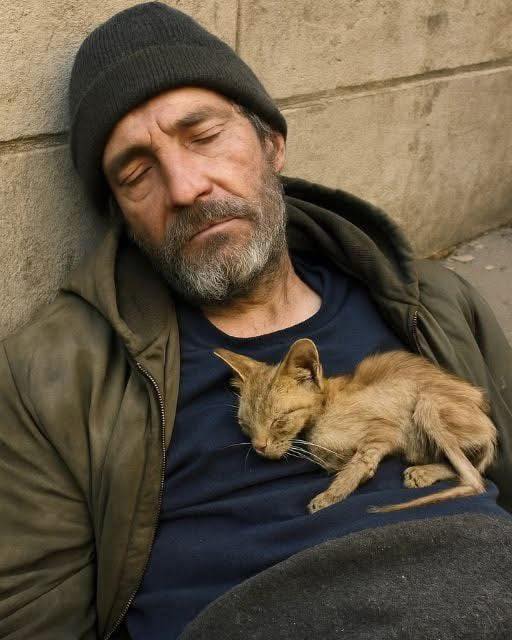
He was supposed to disappear like everyone else.
That’s what cities do to people like him. They swallow them whole without a sound. One day you notice a man sitting outside the convenience store with tired eyes and a cardboard cup, and a week later he’s gone, replaced by someone new, someone equally invisible. Faces blur together in a city that never slows down long enough to care. People pass by with their heads lowered, chasing trains, deadlines, and glowing phone screens, pretending not to notice the lives unraveling at the edges of the sidewalk.
But he didn’t disappear.
Maybe it was because of the cat.
A small orange thing with one torn ear and cloudy golden eyes, curled against his chest like she had chosen him out of all the lonely souls in the world. She followed him everywhere, rode on his shoulder sometimes like a lookout, slept tucked beneath his coat at night while traffic hissed by in the rain. I never learned where she came from, and I don’t think he knew either. Some stories begin quietly like that — two broken creatures finding each other at exactly the right moment.
I watched them for months.
Through winter winds that cut through alleyways like knives. Through hungry evenings when he split the last piece of bread in half and pretended he wasn’t hungry so she could eat first. Through nights when the rain soaked everything they owned and he still laughed softly when she pawed at the dripping water. I watched strangers ignore him, avoid him, step around him like he was debris left behind by the city itself.
But whenever someone stopped long enough to really look at him, they saw the same thing I did.
He loved that cat more than he loved himself.
The coldest night of the year arrived without mercy. The kind of cold that burns your lungs when you breathe too deeply, the kind that turns sidewalks into sheets of silver ice and sends everyone rushing indoors. I remember my fingers aching even inside gloves as I carried two cups of coffee down the street toward the corner where he usually slept.
He wasn’t lying down that night.
He sat upright against the brick wall, awake and shivering beneath the weak glow of a streetlamp. His coat — the only thick thing he owned — was wrapped entirely around the cat sleeping in his lap. She looked warm. He didn’t.
His hands were bare, red from the cold, trembling so badly he could barely hold the cup when I offered it to him. Still, he smiled.
Not the desperate smile people use when they want something from you. A real one. Small and tired, but genuine.
“She’s not used to this kind of cold,” he said softly, glancing down at the cat as she blinked up at him.
Like he wasn’t freezing himself.
I sat beside him for a while, listening to the distant sirens and the rattle of trains overhead. The city moved around us, uncaring as ever. Snow had started to fall, light and slow, dusting his shoulders white.
That was when the outreach van arrived.
Its headlights swept across the sidewalk before the engine idled to a stop. Two workers stepped out bundled in heavy coats, carrying blankets and offering the same practiced kindness they probably offered every night.
They told him there was room at a shelter.
A warm bed.
Hot food.
A shower.
A way out of the cold.
For a second, I thought he might say yes.
He listened carefully, nodding at every word. Hope flickered across the faces of the workers as they explained everything waiting for him inside that heated building. Safety. Warmth. Another chance.
Then he looked down at the cat curled against his chest.
“Can she come too?” he asked.
The workers hesitated.
I already knew the answer before they said it.
“No pets allowed.”
It was always no.
No room for animals. No exceptions. No understanding that sometimes love is the only reason a person survives long enough to need saving in the first place.
The street fell quiet after that.
Snow drifted between us in soft white flakes. One of the workers tried again, explaining policies, apologizing gently, promising the cat would probably survive outside for one night.
But he shook his head before they could finish.
Then he looked at me.
And I swear I had never seen his eyes so clear.
Not angry. Not broken. Just certain.
“I won’t leave her,” he said softly.
The words barely rose above the wind, but they carried more weight than anything else I’d heard all winter.
The outreach workers stood there another moment, helpless against rules written somewhere far away by people who had probably never loved anything enough to freeze for it. Eventually, they climbed back into the van.
The doors shut.
The engine rumbled.
And the van drove away empty.
I stayed a little longer after that. Long enough to watch him tuck the cat deeper into his coat. Long enough to hear her purring faintly against his chest while snow gathered at his feet. Long enough to wonder how a world could fail someone so completely and still leave him capable of that kind of loyalty.
When morning came, he was gone.
No sign of him. No sign of the cat.
Only the flattened imprint of his mat pressed into the frozen concrete, already filling with snow, and a single strand of orange fur clinging stubbornly to the ground beside it.
The city moved on like it always does.
But sometimes, when winter comes back and the nights turn sharp and bitter, I still think about him — the man everyone was supposed to forget, and the little half-eared cat who made sure I never could.