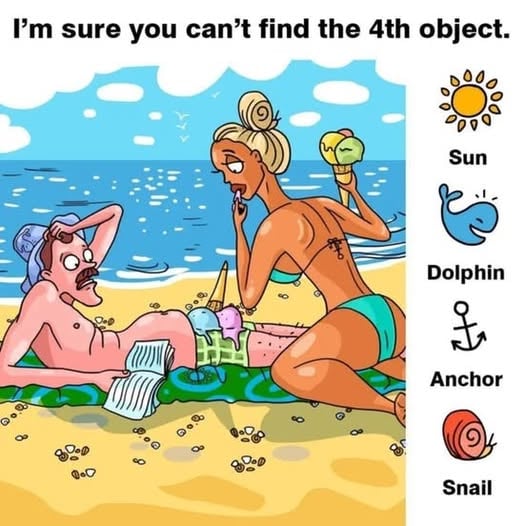
The clock is ticking, the waves are rolling in, and the beach scene before you seems almost too peaceful to be dangerous. Bright umbrellas sway under the golden sun, towels are scattered across the warm sand, and somewhere beyond the shore, a playful dolphin leaps through the sparkling water. At first glance, it feels like the perfect summer postcard—calm, colorful, and harmless. But hidden inside this relaxing image is a tiny intruder determined to challenge your confidence and test the limits of your focus.
You instantly spot the obvious details. The shining sun catches your eye within seconds. The dolphin practically reveals itself. Even the anchor, cleverly blended into the scene, eventually gives in to your persistence. Yet there’s one final object that refuses to appear. That mysterious fourth shape lingers just out of reach, turning what seemed like a simple game into an oddly personal battle between you and the puzzle itself.
And that’s exactly what makes this beach brain teaser so addictive.
It’s not just about finding hidden objects—it’s about the way your mind reacts when something stays unsolved. You begin casually, scanning the waves and seashells with relaxed curiosity. But the longer the final object remains hidden, the more intense the challenge becomes. Your attention sharpens. Your breathing slows. The outside world fades away as your entire focus narrows to a few stubborn inches of sand and shadow. What started as light entertainment suddenly becomes a full mental mission.
That transformation—from passive observation to deep concentration—is where the real magic happens. Without even realizing it, your brain shifts into problem-solving mode. Every glance across the image becomes more deliberate. Every tiny detail starts to matter. You notice patterns you would normally ignore: a curve that doesn’t belong among the shells, a shadow that feels slightly out of place, or a faint spiral shape half-hidden beside a beach towel. Your eyes learn to question what they see instead of accepting the scene at face value.
These puzzles are more powerful than they appear because they quietly train the brain while keeping you entertained. Each attempt strengthens your attention span, visual memory, patience, and ability to recognize subtle details under pressure. The challenge pushes your mind to stay engaged, adapt quickly, and search creatively instead of relying on obvious answers.
And then comes the most satisfying moment of all—the instant the hidden object finally reveals itself. Suddenly, what seemed impossible becomes impossible to unsee. You wonder how you missed it for so long, and your brain rewards you with that small rush of excitement that makes you want to try another puzzle immediately.
But even if you don’t find the final object right away, the experience still leaves its mark. Whether you eventually discover the elusive snail hidden in the sand or walk away promising yourself one more try later, your mind has already benefited from the challenge. In those quiet moments of searching, you’ve strengthened focus, patience, observation, and mental endurance—one deceptively simple beach day at a time.