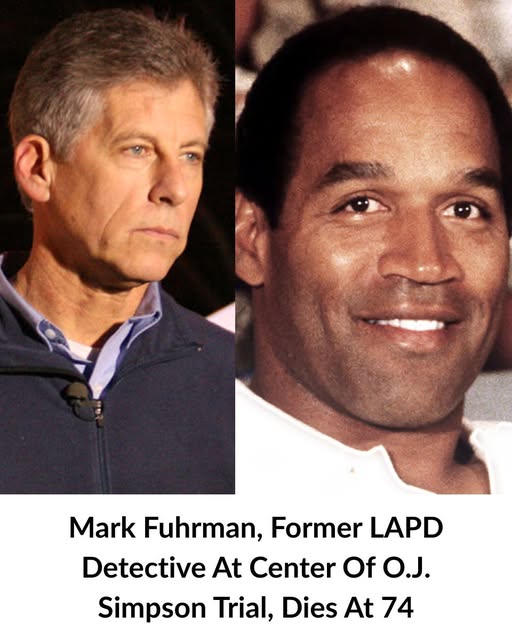
Mark Fuhrman is dead, and with his passing ends one of the most controversial and unforgettable chapters in modern American legal history. Even decades later, his name still sparks fierce debate, whispered accusations, and unresolved anger. To some, he was the detective who uncovered critical evidence in the most infamous murder case of the 20th century. To others, he became the living symbol of everything Americans feared about racism, corruption, and abuse within law enforcement. Few figures have ever fallen so dramatically in the public eye, and even fewer left behind a legacy so tangled in truth, scandal, and national division.
The former LAPD detective died quietly in Idaho at the age of 74, reportedly after battling throat cancer and choosing to end treatment. There was no public memorial, no emotional farewell, no final attempt to explain or defend himself. Instead, the silence surrounding his death feels hauntingly appropriate for a man whose life became consumed by one of America’s loudest and most explosive courtroom dramas. Yet with that silence comes the return of old questions that never truly disappeared. Did Fuhrman’s racism poison the integrity of the O.J. Simpson investigation? Was he a dishonest officer who helped compromise justice, or a deeply flawed detective destroyed by a media firestorm larger than himself? And perhaps most chilling of all: what does it say about the “Trial of the Century” that the only person ever convicted in connection to the murders was not the accused celebrity, but the detective investigating the case?
Fuhrman became a household name during the 1995 O.J. Simpson murder trial, a case that gripped America with an intensity rarely seen before or since. The nation watched as every detail unfolded live on television: the blood evidence, the gloves, the celebrity spectacle, the racial tensions, and the emotional courtroom battles that divided the country along deeply painful lines. At the center of it all stood Fuhrman, the veteran detective whose discovery of the infamous bloody glove at Simpson’s estate initially appeared to strengthen the prosecution’s case. For a moment, he seemed to embody the determined investigator chasing justice in a brutal double homicide.
But that image collapsed with astonishing speed.
Defense attorneys uncovered audio recordings in which Fuhrman repeatedly used racist slurs and described violent misconduct toward Black citizens. Under oath, he had denied using such language in the previous decade. The revelation detonated inside the courtroom like a bomb. Suddenly, the prosecution’s key detective no longer appeared trustworthy. His credibility shattered before millions of viewers, and the damage extended far beyond one witness. Fuhrman’s lies gave the defense an opening to argue that racism within the LAPD had contaminated the entire investigation. For many jurors and observers, the case stopped being only about evidence and became a larger referendum on policing, race, and institutional bias in America.
The impact was enormous. Fuhrman later pleaded no contest to perjury for lying under oath, making him the only individual criminally convicted in relation to the Simpson case. That fact alone remains one of the most astonishing ironies in American legal history. The detective who helped build the prosecution’s narrative became the one person legally punished when the trial was over.
Yet even after the verdict that stunned the nation, Fuhrman never truly disappeared. He reinvented himself as an author, radio host, and television commentator, eventually becoming a familiar face on Fox News. He wrote books about crime and policing, analyzed investigations on television, and attempted to reshape his public image. But no amount of reinvention could fully separate him from the shadow of the Simpson trial. His name had already become part of America’s cultural vocabulary, permanently tied to debates about racism in law enforcement and the fragile nature of public trust.
To critics, Fuhrman remained the embodiment of systemic prejudice and police dishonesty—a cautionary tale about how bias can infect justice itself. To supporters, however, he became something different: a scapegoat sacrificed by a collapsing prosecution and a sensationalist media culture desperate for a villain. Those opposing interpretations survived for decades, refusing to fade even as the trial itself passed into history.
Now, with his death, those arguments return once again. But this time there will be no courtroom testimony, no cross-examination, no televised defense. Mark Fuhrman leaves behind no final statement capable of resolving the contradictions that defined his life. Instead, he leaves an uneasy legacy suspended somewhere between guilt and victimhood, between truth and deception, between justice pursued and justice compromised.
In the end, perhaps that is why his story still unsettles America after all these years. Fuhrman was never just one man. He became a mirror reflecting the nation’s deepest anxieties about race, policing, celebrity, media power, and the reliability of the justice system itself. His death closes a life, but not the argument that surrounded it. That debate—raw, emotional, and unresolved—may outlive everyone connected to the trial.