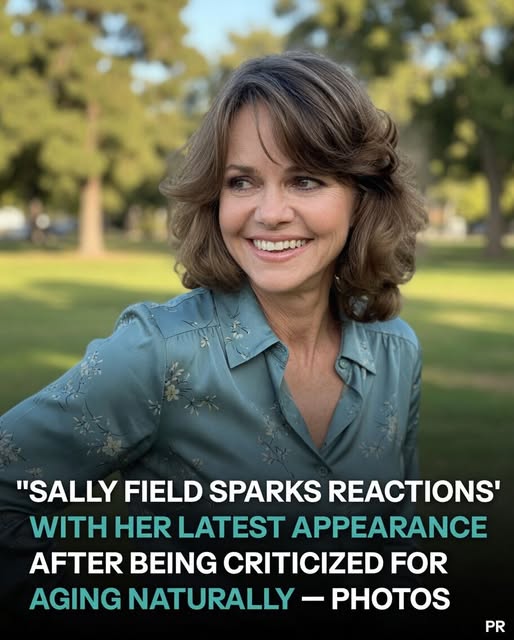
The video is only a few seconds long, yet it lands with the emotional force of something far bigger — like a quiet scene that somehow says everything at once.
There’s no cinematic polish here. No soft-focus glamour lighting, no carefully curated backdrop, no edited perfection designed to flatten time. Instead, it’s just Sally Field — 79 years old — moving through the restless rhythm of a New York City street, where the crowd never really stops and yet, for a moment, everything seems to pause around her.
People recognize her instantly. And just like that, the sidewalk becomes something else entirely: a living current of excitement. Strangers turn into fans in an instant, reaching out, calling her name, trying to steal a moment of connection in the middle of the rush. She responds not with distance or detachment, but with a kind of amused, affectionate urgency — smiling, laughing, gently urging them to be “quick, quick,” as if she’s both part of the chaos and slightly trying to keep up with it.
And still, she stops. Over and over again. She signs. She acknowledges. She meets people where they are, even as the city pushes forward without waiting for anyone.
What truly struck people wasn’t simply that she was gracious with fans — it was how unguarded she appeared while doing it.
In a world that so often rewards filtering, smoothing, tightening, and erasing anything that hints at age, Sally Field appears with none of that armor. Casual clothing. A bare, natural face. Hair unstyled in any performative way. And yet, what reads most clearly isn’t “lack of effort” — it’s ease. A deep, unforced comfort inside her own life, her own body, her own years.
There is something quietly radical in that.
Because what viewers don’t see is withdrawal or invisibility — the things society often tries to assign to aging women. Instead, they see presence. Full, grounded, unmistakable presence. A face that doesn’t try to deny time, but instead reflects it. Every line, every shift, every softness feels less like loss and more like accumulation — as if her expressions are not worn down by years, but written by them.
And then there’s her smile — not performative, not rehearsed, but warm in a way that feels instinctive. The way she leans toward people instead of away from them carries its own quiet message: I am still here, and I am still with you.
That small sidewalk exchange began circulating not just because she was kind, but because it disrupted something deeper in the cultural imagination. In a society that often equates value with youth, especially for women, seeing someone so unmistakably themselves — unhidden, unfiltered, unafraid — felt almost like a challenge to the usual narrative.
Sally Field has spoken for years about aging, about how harshly the world can treat women once their appearance no longer fits a narrow definition of “young.” She has pushed back against the idea that visibility fades with age, or that beauty must be frozen to remain valid. But words can sometimes feel distant — abstract, even polite.
This moment wasn’t abstract.
It was lived.
A brief encounter on a busy street became something larger: a reminder that aging does not erase a person’s right to be seen, touched, loved, or celebrated. That warmth can be more magnetic than perfection. That history written on a face can be more compelling than any illusion of smoothness.
And perhaps most powerfully of all, it offered a simple, unspoken truth to everyone who watched it unfold:
Real beauty doesn’t ask to be younger. It simply asks to be allowed to exist.