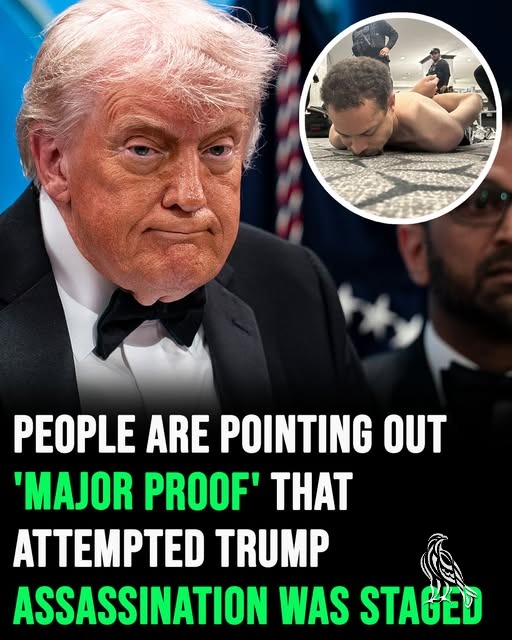
The room went silent a split second before chaos erupted. Laughter still echoed beneath the chandeliers, cameras were still rolling, and the polished spectacle of power and celebrity carried on as if nothing could pierce it. Then came the gunfire. In an instant, glamour collapsed into terror. Faces once fixed in practiced smiles twisted into panic, security agents lunged into motion, and the footage—captured from every possible angle—began its transformation from breaking news into digital obsession. Within hours, millions online were dissecting every frame, every expression, every word, searching not only for answers, but for hidden meaning.
And almost immediately, the question spread like wildfire across social media feeds and livestreams: was this truly an assassination attempt, or had the world just witnessed the darkest form of political theater imaginable?
One careless remark. One awkward joke from Karoline Leavitt that resurfaced in clipped, contextless fragments. One viral video slowed down, zoomed in, replayed endlessly. That was all it took for suspicion to explode. Across TikTok threads, YouTube breakdowns, and late-night livestream debates, amateur detectives began constructing elaborate narratives that blurred the line between speculation and certainty. To some, the footage became proof of orchestration. To others, it was evidence of how deeply paranoia has embedded itself into public life. Facts no longer arrived alone; they arrived already wrapped in competing interpretations.
In the days since the shooting, the event has evolved into something far larger than a single act of violence. It has become a reflection of a nation fractured not only by politics, but by reality itself. Investigators continue to reconstruct the attack through evidence: timelines mapped minute by minute, ballistic reports analyzed in painstaking detail, motives traced through digital footprints and personal history. Their portrait is stark and disturbingly familiar—a lone attacker consumed by anger, resentment, and the desire to shatter the illusion of untouchable power inside a room built on influence, laughter, and performance.
Yet beyond the official investigations, another trial is unfolding online. There, certainty is shaped not by evidence, but by virality. Every pause in the footage becomes suspicious. Every gesture becomes symbolic. Karoline Leavitt’s offhand quip is replayed as though it were a coded confession instead of what many insist was simply a failed attempt at humor under pressure. Entire communities have become consumed with decoding hidden signals, convinced that nothing unfolding before them can ever be taken at face value again.
What remains after the headlines fade is something even more unsettling than the attack itself: the collapse of shared trust. Not merely trust in politicians, institutions, or media organizations, but trust in reality as a common experience. The bullets were real. The panic was real. The blood staining the floor was real. Survivors did not imagine the fear that swept through the room. And yet, for millions watching from behind screens, reality alone no longer feels convincing enough. Every tragedy is instantly reframed as a puzzle, every catastrophe transformed into content, every moment subjected to the suspicion that somewhere behind the curtain lies a script no one is meant to see.
That may be the most dangerous consequence of all. A society unable to agree on what happened becomes a society incapable of deciding what must happen next. When truth itself fractures into endless personalized versions, accountability dissolves, justice becomes impossible to define, and fear fills the vacuum. The shooting was one moment of violence, but the aftermath revealed something deeper: a culture trapped between spectacle and distrust, where even horror is no longer experienced together, only argued over in fragments.
And so the footage keeps playing. The cameras never stopped rolling. Neither, it seems, has the nation’s unraveling.