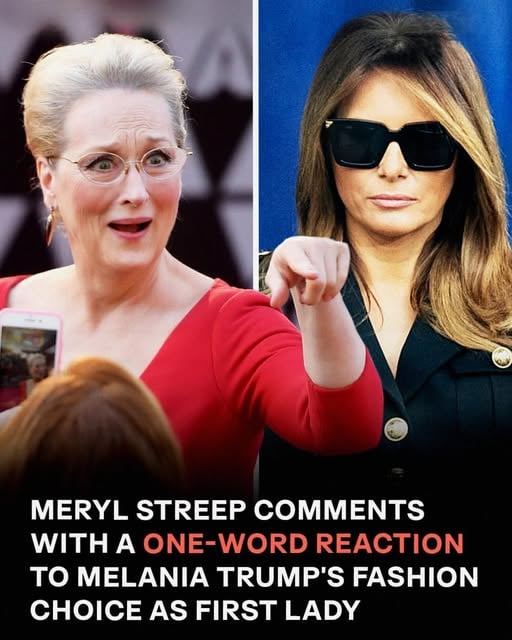
Meryl Streep didn’t raise her voice when she spoke with Anna Wintour. She didn’t need to. The subject itself carried enough weight: a green Zara jacket worn by Melania Trump in 2018, stamped with five words that would ricochet across headlines, television panels, and social media feeds around the world: “I Really Don’t Care, Do U?”
It was more than a fashion controversy. It became a cultural rupture.
At the time, the United States was already engulfed in outrage over migrant family separations at the southern border. Images of children behind fences and recordings of crying toddlers had ignited national grief and fury. Against that backdrop, Melania Trump boarded a plane to visit a detention facility wearing a casual military-style jacket whose message seemed impossibly disconnected from the suffering dominating the national conversation. Within minutes, the photograph became unforgettable — not because of the jacket itself, but because of the emotional collision it created.
In her recent reflection, Meryl Streep explored something deeper than celebrity scandal or political theater. She dissected the frightening power of visual symbolism in modern public life. In an era where every appearance is photographed, archived, reposted, and endlessly analyzed, clothing no longer functions as mere personal style. It becomes language. It becomes policy. It becomes moral positioning — whether intentional or not.
Melania Trump later claimed the message on the jacket was directed at the media, not at migrant families or the humanitarian crisis unfolding at the border. But by then, the image had already escaped explanation. Public symbols rarely wait for clarification. Once released into the cultural bloodstream, they gather meanings of their own. The photograph hardened into something larger than fashion commentary: a symbol of emotional distance at a moment demanding compassion.
That is the tension Streep seems most interested in — the dangerous gap between image-making and human consequence. The jacket itself was inexpensive, ordinary, almost forgettable. Yet the words printed across its back transformed it into one of the defining visual moments of a politically fractured era. Not because people cared about Zara, or celebrity style, or trends, but because the image appeared to communicate indifference in the face of visible suffering.
What lingers years later is not the fabric, the cut, or even the political spin that followed. What remains is the dissonance. A nation confronting trauma saw a public figure wrapped in a message that seemed to dismiss empathy altogether. And once that contradiction was captured in a single frame, it became impossible to separate aesthetics from accountability.
Streep’s observation cuts to the heart of modern power: today, leaders do not communicate only through speeches or policy decisions. They communicate through symbols, gestures, photographs, and silence. Every public image carries emotional and political weight. Fashion, once dismissed as superficial, can suddenly become historical evidence — a visual shorthand for how a moment felt.
The jacket now exists as more than a controversial wardrobe choice. It survives as a cautionary emblem of how quickly image can eclipse intention, and how public figures can lose control of meaning the instant a photograph enters the world. In the digital age, perception hardens fast. Empathy, meanwhile, remains fragile.
And perhaps that is why the image still unsettles people years later. Because beneath the outrage, beneath the politics, beneath the endless commentary, sits a more uncomfortable question: what does it mean when power appears emotionally disconnected from pain?