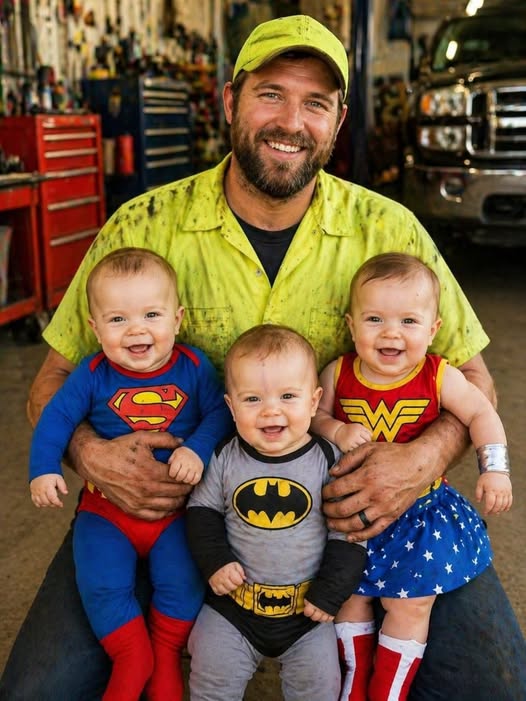
The night he found the wallet, he stood beneath the flickering glow of a broken streetlamp and seriously considered keeping it. His hands trembled as he opened it, not because he was greedy, but because life had pushed him to the edge for far too long. Inside was more cash than he had seen in months—enough to keep the electricity from being shut off, enough to buy groceries that didn’t come from the discount shelf, enough to silence, at least for a little while, the crushing weight of overdue bills stacked across his kitchen table.
For a moment, temptation wrapped around him like a storm.
He thought about his children asleep at home in a tiny apartment where the heater barely worked. He thought about the exhaustion that came from fixing other people’s cars all day while his own life seemed permanently broken. As a mechanic and a single father, he had mastered survival, but survival was not the same as living. Every morning felt like another battle against humiliation, debt, and the quiet fear that no matter how hard he worked, it would never be enough.
No one would know if he kept the money.
No one would blame him if he did.
But something deep inside him refused to let desperation become the thing that defined him.
So instead of slipping the wallet into his pocket and walking away, he searched for the address printed on an old identification card tucked inside. Late that night, tired and ashamed of how badly he had considered stealing from a stranger, he drove across town to a large weathered house standing silent beneath the porch light. He knocked once, then twice, clutching the wallet in rough, grease-stained hands.
An elderly man opened the door.
His tired eyes immediately dropped to the wallet, and for a second, the world seemed to stop. Relief flooded across the old man’s face so suddenly and so deeply that it almost broke the mechanic’s heart.
“You found it,” the man whispered, his voice trembling.
The mechanic nodded and handed it over. “Everything’s still inside.”
The old man tried to offer him some of the money as a reward, but he refused. Pride was one of the few things poverty had not taken from him yet. He simply wished the man a good night and walked back to his truck, believing that would be the end of it.
But the next morning, a police car pulled up outside his apartment building.
His stomach dropped.
Fear rushed through him instantly. He replayed every unpaid parking ticket, every missed payment, every struggle of the past year in his mind. His children watched nervously from the window as two officers stepped out and approached his door.
Then another car arrived.
The elderly man slowly climbed out, holding a small box in his hands.
There was no accusation. No arrest.
Instead, the old man stood before him with tears gathering in his eyes.
“You didn’t just return my wallet,” he said quietly. “You returned my life.”
Confused, the mechanic opened the wallet again and noticed something he had overlooked the night before. Tucked behind the cash were several faded photographs—old, worn pictures of a smiling woman and a young girl.
“My wife and daughter,” the man explained softly. “They passed away years ago. Those photos are all I have left of them.”
The mechanic felt his chest tighten.
The money could have been replaced. The wallet itself meant nothing. But those photographs carried memories that no amount of wealth could ever buy back. In returning the wallet, he had unknowingly saved the last fragile pieces of someone’s family.
From that day on, something unexpected began to grow between the two men.
What started as a simple thank-you turned into weekly visits. The old man would invite the mechanic and his children over for dinner. At first, the mechanic resisted, embarrassed by his worn clothes and tired eyes, but the old man never cared. He simply enjoyed hearing laughter inside his home again—a sound that had been missing for years.
Slowly, the silence in that old house began to disappear.
Six months later, the mechanic’s triplets could be seen racing across the old man’s backyard every Saturday morning, their laughter echoing through the trees like music. The scent of fresh coffee and cut grass drifted through the air while toy trucks rolled across the porch steps. What had once been a lonely house filled with grief had become alive again.
And for the first time in years, the mechanic no longer carried the weight of the world alone.
One warm afternoon, as the old man sat watching the children play in the yard, the mechanic’s little daughter climbed into his lap and looked up at him with innocent eyes.
“Are you our grandpa now?” she asked softly.
The old man’s face crumpled with emotion.
For a moment, he couldn’t speak.
Then he smiled through tears and wrapped his arms around her.
“Yes,” he whispered. “I think I am.”
And in that quiet moment, two broken lives—one shattered by loss, the other worn down by struggle—came together to form something neither of them had expected:
A family built not by blood, but by kindness, honesty, and one impossible act of doing the right thing when it would have been easier not to.