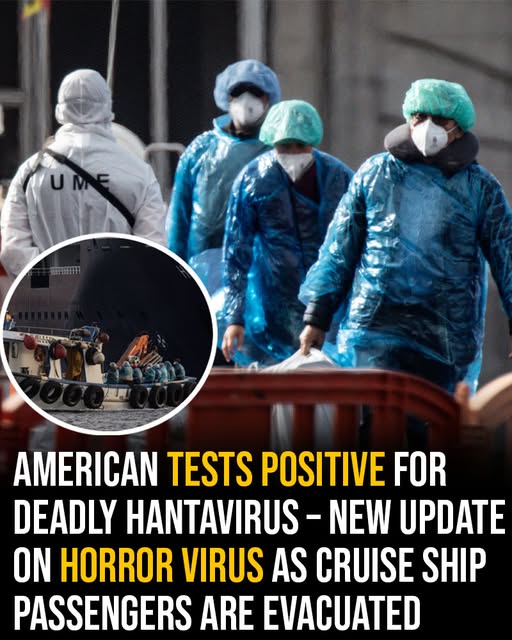
What was meant to be the voyage of a lifetime descended into chaos, panic, and fear as the luxury expedition cruise turned into an unfolding global health emergency. Passengers who had boarded the MV Hondius expecting breathtaking scenery and unforgettable memories instead found themselves trapped inside what many described as a floating biohazard zone. Under the harsh glare of military floodlights, terrified travelers rushed down gangways clutching bags, children, and protective masks while armed security forces and hazmat teams surrounded the ship. Helicopters thundered overhead. Emergency sirens echoed across the docks. And somewhere among the hundreds on board was one confirmed American infected with a dangerous virus whose true reach remains unknown.
Officials continue to insist the public risk is “low.” Yet behind closed doors, governments across more than 20 nations are scrambling to contain a crisis that appears to be evolving faster than authorities can explain it. Emergency quarantine plans are being activated. Medical isolation units are preparing for incoming patients. And fears are growing that the strain detected aboard the vessel may already be mutating.
What began as a peaceful polar-style voyage aboard the MV Hondius quickly transformed into scenes resembling a dystopian thriller rather than a luxury holiday. Witnesses described exhausted passengers lining up for hours beneath cold night air as crews in full-body protective suits escorted them from the ship one by one. Faces were hidden behind fogged respirators and plastic shields, creating an atmosphere so tense that many travelers said they felt as though they were entering a war zone instead of a rescue operation. Some passengers broke down in tears as families were separated according to nationality, with officials directing them toward different military aircraft bound for different countries, uncertain quarantines, and uncertain futures.
The confusion only deepened as international response teams moved rapidly to evacuate citizens before borders tightened further. Military transport planes waited on nearby runways while health authorities attempted to trace every possible exposure. Travelers reported conflicting instructions, limited information, and growing fear spreading faster than the illness itself. Parents held masks tightly against their children’s faces. Crew members avoided direct contact whenever possible. Rumors of additional symptomatic passengers circulated through terminals and hotel quarantine sites long before officials addressed them publicly.
Now, in cities including Madrid, Paris, and soon several locations across the United States, elite medical teams are racing to stay ahead of the threat. The infected American passenger is expected to be transferred into one of the world’s most advanced biocontainment facilities, where specialists in infectious disease will monitor every symptom and every possible mutation. Meanwhile, fellow travelers face days — and for some, potentially weeks — of medical testing, isolation, surveillance, and unanswered questions about what they may have already been exposed to during the voyage.
The World Health Organization continues to stress that widespread contagion remains unlikely. But the haunting images emerging from Tenerife tell a far more unsettling story. Rows of masked passengers. Armed escorts. Biohazard teams disinfecting equipment under floodlights. Families waving goodbye through sealed transport windows with no certainty about when they will see each other again. In moments like these, public trust becomes fragile, because invisible threats often create the deepest fear.
For the passengers stepping off the aircraft and into quarantine facilities around the world, the journey itself may finally be over. But for governments, health officials, and anxious families watching from afar, the real crisis may only be beginning. Behind every official statement promising calm lies a growing uncertainty: how far has the virus already traveled, and what happens if containment fails?