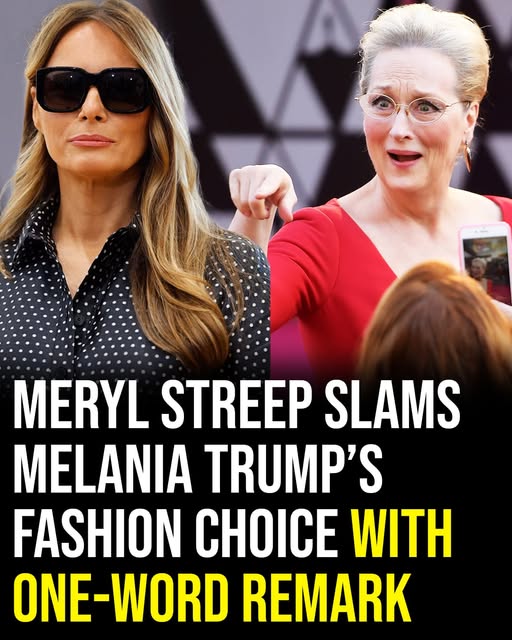
Meryl Streep didn’t mince words. In a striking and emotionally charged new conversation with Vogue, the legendary actress revisited one of the most controversial fashion moments in modern political history: Melania Trump’s infamous green jacket emblazoned with the words, “I Really Don’t Care, Do U?” What may have once been dismissed by some as a careless wardrobe decision has now resurfaced as a haunting symbol of power, privilege, and emotional detachment — and Streep’s reflections have reignited the debate with fresh intensity.
Her comments pierced through years of political spin and public distraction, dragging the image of that Zara jacket back into the national conversation. The moment remains impossible to forget: Melania Trump boarding a plane to visit detained migrant children at the U.S.-Mexico border while wearing a coat that appeared to broadcast indifference at the exact moment empathy was most needed. At the time, explanations ranged from misunderstanding to media manipulation, but Streep now argues that the message was far more revealing than accidental.
Calling it “the most powerful message” Melania Trump ever delivered publicly, Streep reframed the incident not as a fashion mistake, but as a chilling expression of distance from human suffering. Her interpretation strips away the glamour and forces attention onto a deeper truth: when someone occupies one of the most visible positions in the world, nothing they wear exists in isolation. Every image becomes political. Every symbol carries weight. And every public gesture has consequences.
According to Streep, clothing on a global stage is never neutral. It can comfort, unite, and humanize — or it can become a weapon of coldness and exclusion. In her view, the jacket symbolized more than one controversial headline; it reflected a broader culture of indifference that had begun to define political discourse during that era. The actress suggested that the true danger was not simply the words stitched onto fabric, but what those words communicated to millions watching around the world: that compassion could be treated as optional.
Streep also drew a powerful connection between the jacket controversy and Donald Trump’s widely criticized mocking of a disabled reporter during his presidential campaign. By linking these moments together, she painted a larger picture of how public behavior from powerful figures shapes social attitudes. When cruelty, ridicule, or apathy are displayed openly by leaders, she argued, they slowly become normalized in everyday life. What begins at the top eventually trickles down into culture itself — into schools, workplaces, online spaces, and ordinary interactions between people.
Her reflection transforms the conversation from one about fashion into one about responsibility. It is not simply about a coat, a slogan, or a headline from years ago. It is about the signals leaders send, intentionally or not, and the emotional climate those signals create. Public figures do not merely reflect society; they influence it. They teach people, through words and imagery alike, what deserves compassion and what can be ignored.
That is why the jacket still lingers in public memory years later. In a world flooded with carefully managed images, that single phrase became unforgettable because it appeared brutally honest. Whether interpreted as defiance, carelessness, or calculated messaging, it exposed something raw about the relationship between power and empathy. Streep’s comments force audiences to confront that discomfort again, reminding us that symbols matter — especially when they emerge from the highest levels of influence.
In the end, her critique goes beyond politics altogether. It becomes a warning about the normalization of emotional detachment in modern culture. A sentence printed across the back of a jacket became more than fashion; it became a mirror reflecting what society chooses to tolerate from those in power. And according to Streep, once indifference is publicly accepted, its consequences ripple far beyond a single moment, quietly shaping how people treat one another long after the cameras disappear.