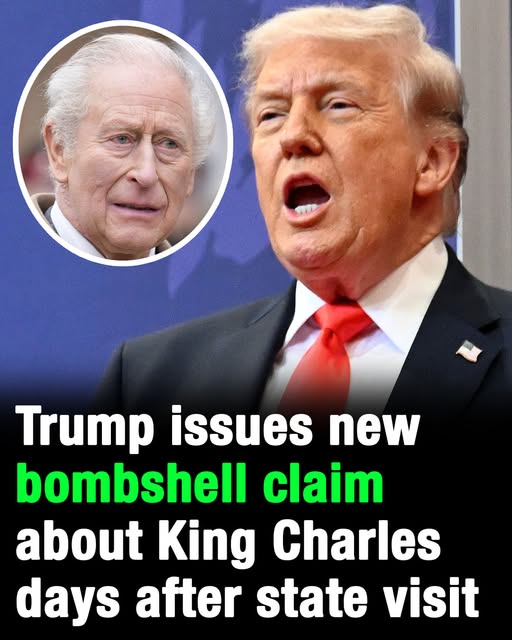
Trump didn’t just raise a glass — he lit a fuse beneath a centuries-old institution.
What began as a polished State Visit, all handshakes and ceremonial toasts, quickly veered into something far more combustible. In a moment that seemed casual but carried real consequence, Trump publicly implied that King Charles stood behind his hardline stance on Iran. It was a striking claim — and a deeply uncomfortable one for Buckingham Palace. Within hours, royal aides were forced into the rare position of issuing not one, but two clarifications, carefully reiterating a principle that underpins the monarchy itself: the King does not take sides, and certainly not in the political battles of foreign leaders.
But the drama didn’t end there.
Just as the royal plane lifted off, Trump shifted gears — and headlines — again. In a move framed as both tribute and triumph, he abruptly announced the rollback of U.S. tariffs on Scottish whisky, declaring it was done “in honor” of King Charles and Queen Camilla. He praised the decision as a breakthrough, claiming it achieved what “nobody else was able to do.” On the surface, it sounded like a gesture of goodwill. Beneath it, however, was something more calculated: a policy pivot wrapped in royal symbolism.
The Palace responded the only way it could — with grace, diplomacy, and a carefully measured tone. There were mentions of shared heritage, drams raised in appreciation, and polite acknowledgment of the gesture. Yet behind that refined language lingered a palpable tension. The monarchy, built on neutrality, had been pulled — however subtly — into the machinery of political messaging and economic maneuvering.
In the span of a single visit, a ceremonial encounter had been transformed into a high-stakes performance. A king became a talking point. A toast became leverage. And a long-standing boundary — the separation between crown and politics — was tested under the glare of global attention.
What remained, after the smiles faded and the statements were issued, was a lingering question: when diplomacy becomes spectacle, who is really in control of the narrative?