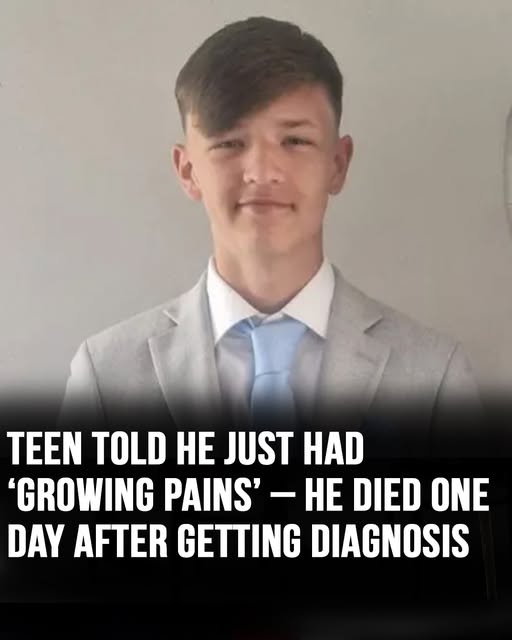
A healthy 16-year-old walked into hospital on what was supposed to be an ordinary day. He never walked out again.
For weeks before that moment, Harley Andrews had been doing what any teenager would do when something doesn’t feel quite right—he mentioned his symptoms, went to see doctors, and tried to carry on with life. He was a fit, active boy who loved football and rugby, the kind of teenager always moving, always training, always laughing with friends. When he complained of pain and fatigue, it didn’t initially raise alarm bells. Doctors reassured his family it was likely something harmless—“growing pains,” maybe a mild viral infection, something that would pass with time.
So Harley kept going. Like so many young people told to “push through it,” he trusted the advice, believing rest and reassurance would be enough.
But beneath those quiet, misleading symptoms, something far more serious was unfolding.
By the time the truth finally came into focus, it was already devastatingly advanced. After further tests and scans, the word no family ever wants to hear entered the room: leukemia. And not in an early, treatable stage—but already aggressive, already widespread, already overwhelming his body. In an instant, what had been uncertainty turned into urgency, and urgency turned into a race no one was prepared for.
Harley was rushed to Royal Bolton Hospital, where doctors confirmed the severity of his condition. The diagnosis was brutal: stage four leukemia had already spread to his brain and vital organs. Internal bleeding had begun, and his body was being pushed past the limits of what medicine could stabilize in time.
What followed was not days or weeks of preparation, but hours of shock.
His parents, still trying to process the words they had just heard, barely had time to hold onto hope before everything changed again. The medical teams worked urgently, but the illness had progressed too far, too fast. In the early hours of the next morning—just a single night after arriving at hospital—Harley’s life came to a sudden and heartbreaking end.
He was 16 years old.
A boy who had walked into hospital with his future still stretching out in front of him was gone before dawn.
Those who knew him describe Harley as someone who brought energy wherever he went. On the pitch, he was the kind of player teammates relied on—not just for skill, but for spirit. Off it, he was a protective older brother to six siblings, known for his warmth, his humour, and the way he made people feel included without effort. He wasn’t just part of a group; he was often the one who held it together.
Now, in the aftermath of his passing, that same community is trying to hold his family together instead.
Friends, relatives, teammates, and strangers have come forward in support, rallying around a GoFundMe campaign created to help give Harley the dignified farewell he deserves. The goal is not only to ease the financial burden of an unimaginable loss, but to honour a life that ended far too soon—one that touched more people than anyone fully realized until it was gone.
In the quiet left behind, there is grief, disbelief, and anger at how quickly everything unfolded. But there is also a determination: that Harley Andrews will not be remembered only for how his story ended, but for the light he carried while he was here, however briefly that time may have been.