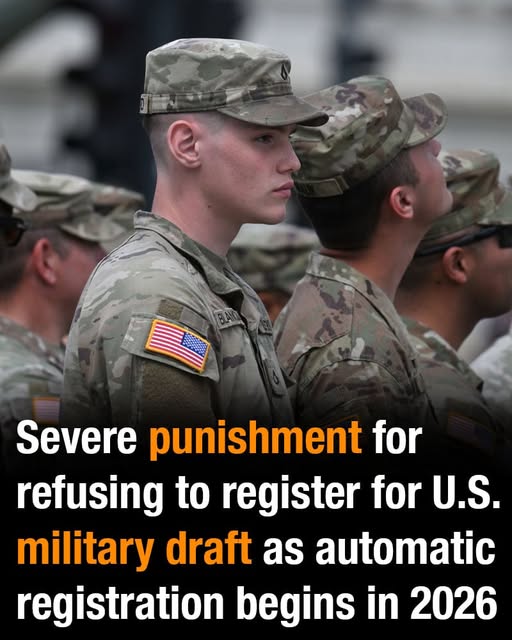
The clock is already ticking, even if it doesn’t feel like it—and almost nobody is really talking about it in a way that matches how serious the consequences can be.
There’s a quiet but important shift happening inside the Selective Service System, and it could end up affecting something most 18-year-olds never connect to it: access to opportunity. Things like federal student aid, certain government jobs, job training programs, and even some professional licenses can quietly hinge on whether a young man is properly registered. Not later. Not eventually. But exactly when the system expects it.
What makes this especially risky is how invisible it feels in everyday life.
Parents often assume it’s handled automatically—something the school, the government, or some digital system will take care of in the background. Teenagers, on the other hand, usually assume it doesn’t really apply to them or that it will “sort itself out later.” The problem is that both assumptions can lead to the same outcome: a missed requirement that isn’t easily reversible.
Right now, the rules remain straightforward in practice. If you are a male U.S. citizen or immigrant approaching 18, you are generally expected to register with Selective Service within a specific window. That responsibility still rests on the individual, even as discussions about modernization and automation continue. And here’s the part that catches people off guard—if the registration is missed, it doesn’t simply disappear into a system that fixes itself later.
Years down the line, when someone applies for FAFSA, a federal position, or a state-issued professional license, that missing registration can suddenly reappear as a barrier. At that point, it isn’t a quick correction. It can mean delays, additional steps, or in some cases, losing eligibility entirely until the issue is formally resolved. And unfortunately, “I thought it was automatic” is not considered a valid fix when the system is checking eligibility.
For families already overwhelmed with school paperwork, financial aid forms, college applications, and deadlines that never seem to slow down, Selective Service often looks like just another checkbox in a long list. But this particular checkbox carries a different weight. It is directly tied to future opportunities—ones that don’t feel urgent at 18, but become extremely important at 20, 22, or later.
That’s why the safest approach during this transition period is not complicated, but it is important:
Go directly to official government sources. Verify whether registration is complete. Save confirmation or proof somewhere secure. And don’t rely on assumptions, rumors, or half-heard updates about future automation in 2026 or beyond.
Because even if systems change later, your eligibility decisions today are still based on what is properly recorded now.
A few quiet minutes of checking and confirming may not feel significant in the moment. But years from now, it could be the difference between doors that open easily—and doors that stay firmly closed when you least expect it.