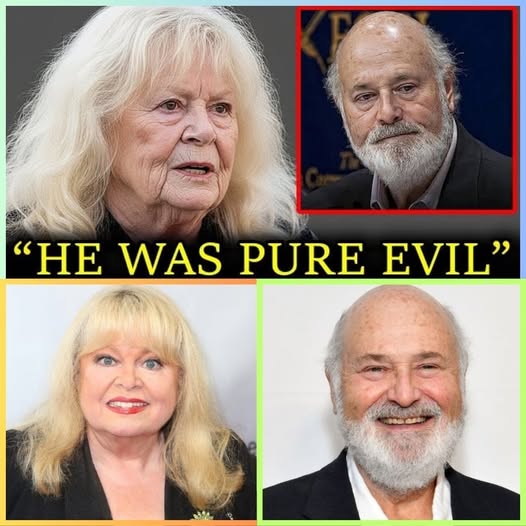
The lie had taken root in her throat so long ago that it felt almost like a second voice—one that spoke when she couldn’t, one that softened the edges of truth until even she could pretend not to see them clearly. For years, Sally Struthers had carried it with practiced ease, dressing it up in loyalty, in friendship, in the quiet justifications that make difficult things easier to live with. But tonight, beneath the glittering chandeliers and the easy sparkle of champagne flutes, that lie had grown too heavy to hold.
The room shimmered with everything that once thrilled her—laughter rising in bright, effortless waves, cameras catching every angle, every smile polished to perfection. It should have felt familiar, comforting even. Instead, it felt distant, like a stage set she no longer belonged to. Every burst of laughter struck her as brittle, every glance lingered a second too long, as if the room itself were waiting. Watching. Asking.
She had stood in rooms like this for decades, always certain of her place, always certain of the people around her. She had defended him here, more than once—deflected questions with a practiced grace, turned suspicion into anecdotes, doubt into admiration. She had believed in him once. That was the part that lingered the longest, the part that stung. Belief, once broken, doesn’t simply disappear; it fractures, leaving sharp edges behind.
Now the truth—no longer whispers, no longer distant murmurs—pressed against her with undeniable weight. It wasn’t something she had heard anymore; it was something she knew. The kind of knowing that settles deep, impossible to ignore, impossible to explain away. The stories she had dismissed, the uneasy moments she had brushed aside, the things she told herself didn’t quite mean what they seemed—they had rearranged themselves into something undeniable. Something final.
She scanned the room slowly, her gaze moving across faces she had known for years, even decades. People she had laughed with, worked with, trusted. Now they blurred together, not in familiarity but in something far more unsettling. There were those who had suspected, those who had whispered behind closed doors, those who had chosen silence because it was easier—because it kept the world intact. And then there were those like her. People who had chosen not to look too closely, who had wrapped themselves in nostalgia and memory, clinging to who he had been rather than confronting who he had become.
She remembered the beginning with startling clarity—the cramped casting room, the nervous energy, the sense of possibility. That was the version of him she had held onto, the one she had defended long after it stopped aligning with reality. It was easier that way. Safer. Until it wasn’t.
A quiet realization settled over her, calm but unshakable: speaking now wouldn’t undo any of it. It wouldn’t rewrite the past or give back the years she had spent standing beside him, shielding him, believing in something that no longer existed. There was no reclaiming that time. No repairing what had already been done.
But there was still something left—something he had never taken, something no one in that room could claim from her unless she surrendered it herself.
Her integrity.
The thought didn’t arrive with drama or fear. It came simply, clearly, like a door opening after years of being shut. For the first time in a long time, she understood exactly what she had to do.
Around her, the music swelled, filling the space with a kind of artificial triumph. Cameras shifted, circling like quiet predators, capturing fragments of a story they didn’t yet know. Conversations continued, laughter rose again, but she felt separate from it now—untethered from the performance.
Her fingers loosened around the stem of her glass. She set it down carefully, the faint clink almost lost in the noise. A small, deliberate act, but it steadied her. Her shoulders squared, not with defiance, but with certainty.
There would be consequences. She knew that. Headlines would follow. Alliances would fracture. There would be those who turned away, those who denied, those who resented her for breaking the unspoken agreement to keep things as they were. The world she had known might shift in ways she couldn’t yet predict.
But for the first time in years, the path ahead felt honest.
Whatever came next wouldn’t be built on careful omissions or quiet fear. It wouldn’t depend on protecting a version of the past that no longer existed. It would be real, unvarnished, and entirely her own.
And this time—finally—she would not look away.