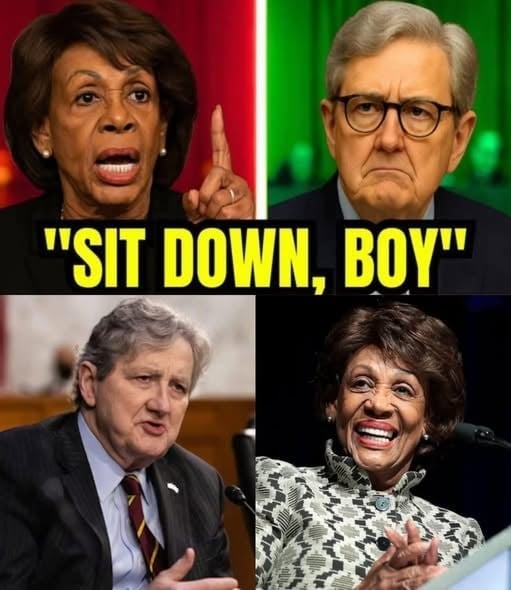
The room didn’t slip into silence—it ruptured. The air cracked with tension as if something invisible had shattered. One insult, just three clipped syllables, and the fragile choreography of American politics came undone in an instant. Every unspoken grievance, every buried rivalry, every raw nerve was suddenly dragged into the light—broadcast live, impossible to ignore. Faces stiffened. Eyes darted. Hands hovered, ready to capture the moment that might define the day, or even the era. No one moved to intervene. No one dared.
And then, almost improbably, stillness entered the chaos.
John Kennedy reached up, removed his glasses with deliberate care, and grounded himself in the center of the storm. It wasn’t hesitation—it was control. What followed wasn’t the explosive retaliation the room braced for. It wasn’t the viral, headline-grabbing clash the cameras silently begged to record. It was something far less expected, and far more unsettling: composure. The kind that doesn’t just respond to conflict—it reframes it entirely.
He could have matched the heat. He had every opening to return the insult, to escalate, to transform the moment into a spectacle of mutual destruction. But he chose a different path. Not out of weakness, but out of discipline. His restraint wasn’t passive—it was strategic. By refusing to lash out, he dismantled the script that had already been written for him. There would be no shouting match, no dramatic spiral into political theater. He denied the moment its chaos. He denied it its easy narrative.
In doing so, he also denied his opponent the satisfaction of escalation—the kind of reaction that turns conflict into performance and reduces people to roles: the aggressor, the victim, the avenger. Kennedy stepped outside of that framework entirely. He didn’t become smaller, and he didn’t try to make anyone else smaller either. He occupied something rarer, something harder to sustain under pressure: self-possession.
That’s why the moment didn’t stay contained within the walls of the committee room. It moved—through screens, across conversations, into the broader national consciousness. Because what people witnessed wasn’t just a political exchange. It was a test of character under a spotlight that rarely forgives imperfection.
And it forced a question that lingered long after the clip ended: What kind of power do we actually admire?
Is it the power to dominate, to humiliate, to win by force of volume and spectacle? Or is it the quieter, more demanding power—the ability to absorb a strike without becoming defined by it? The strength to resist the pull of outrage when outrage is the easiest, most rewarded response?
In a culture that often celebrates the loudest voice, the sharpest retort, the most viral takedown, Kennedy’s response landed differently. It didn’t roar. It didn’t demand applause. It simply stood there, steady and unshaken, offering an alternative vision of strength—one rooted not in reaction, but in control.
And in that stillness, in that refusal to descend into the expected, something more profound emerged: a subtle but unmistakable challenge to the audience itself. Not just to politicians, but to anyone watching.
Because in the end, the moment wasn’t only about what was said. It was about what wasn’t. And sometimes, what you refuse to become in the face of pressure says far more than anything you could ever shout.