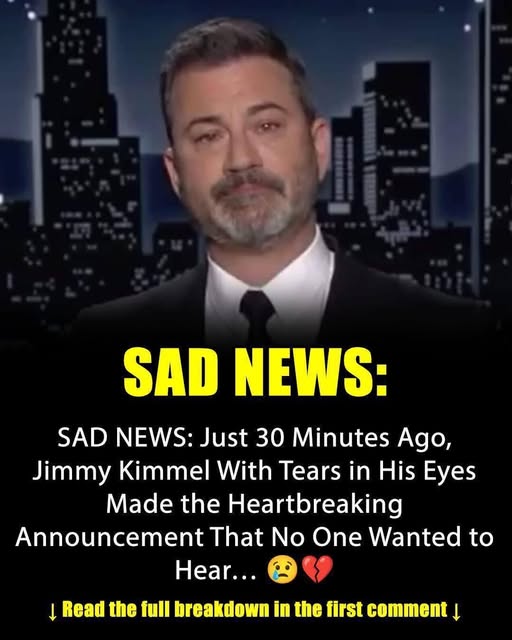
Jimmy Kimmel didn’t step onto his stage that night as the quick-witted comedian millions expect. He walked out as something far more raw, far more human. There was no carefully timed punchline, no polished monologue to ease the tension. Instead, there was silence—heavy, uncomfortable, and real. His voice faltered before he could even find his rhythm. His eyes welled up. On a night that should have been filled with laughter, he struggled just to speak.
This wasn’t performance—it was exposure. The kind you can’t rehearse or hide behind studio lights. Kimmel stood there, visibly shaken, trying to put into words what he called “a terrible night” for America. Every pause, every crack in his voice, made it clear: no script could carry him through this moment. No smile could disguise the weight he felt. For a few minutes, the line between entertainer and citizen disappeared entirely, and millions watching saw not a host, but a man confronting something he deeply feared.
What unfolded wasn’t comedy—it was reckoning. As he spoke about the victory of Donald Trump, Kimmel didn’t frame it as a political talking point. He framed it as a human consequence. His words moved beyond headlines and into lives—immigrants wondering about their future, patients anxious about healthcare, seniors worried about stability, working families bracing for uncertainty, and even allies abroad watching closely. Each group he mentioned added another layer to the heaviness in the room.
The audience tried to respond the only way they knew how—with applause, with encouragement—but it never quite lifted the atmosphere. The tension lingered, almost tangible. What made the moment so striking wasn’t just what Kimmel said, but how deeply he seemed to feel it. His vulnerability peeled back the usual distance between public figure and personal belief. It wasn’t just about politics—it was about a sense of shared values he feared might be slipping away.
The reaction was immediate and deeply divided, reflecting the country itself. Some critics dismissed the monologue as inappropriate, accusing him of turning a comedy platform into a political lecture. Others saw something entirely different: a rare, unfiltered moment of honesty in a space usually built for distraction and escape. In a medium designed to make people forget their worries, Kimmel did the opposite—he admitted he couldn’t forget his own.
And that’s precisely why the moment has lasted. It wasn’t perfect, polished, or even comfortable to watch. But it captured something real—a fracture in American life, unfolding in real time, through someone whose job is usually to make everything feel okay. For a brief, unforgettable stretch, the laughter stopped, and what remained was something far more powerful: truth, uncertainty, and the uneasy recognition that not everything can be turned into a joke.