The room didn’t just laugh—it erupted.
For a brief, shimmering moment, the formal elegance of the White House State Dinner cracked open under the weight of pure, uncontrollable reaction. Laughter rolled across the tables in waves, bouncing off crystal chandeliers and polished silverware. Cameras fired in rapid bursts, capturing every flicker of expression, every reaction, every subtle shift in posture. Glasses clinked mid-toast as guests instinctively paused, caught between decorum and delight.
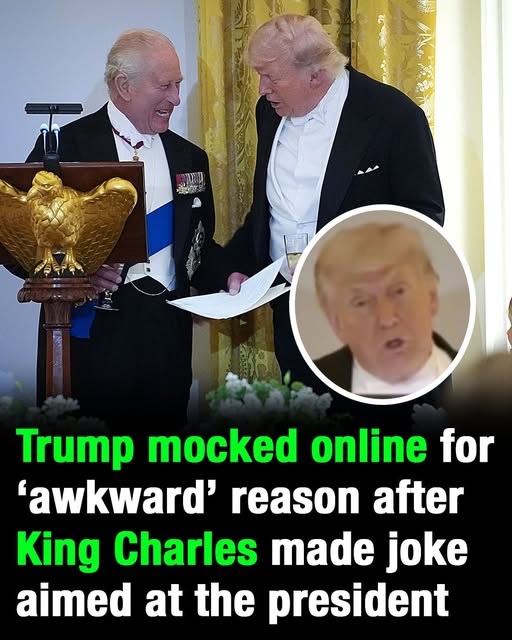
At the center of it all stood King Charles, calm and composed, his expression carrying that familiar blend of royal restraint and quiet mischief. His punchline had landed cleanly—effortlessly—and it carried more than humor. It carried precision.
Across the room, Donald Trump smiled in response, the kind of practiced smile that tries to hold its shape under scrutiny. But behind it, something less certain seemed to flicker—an unreadable moment, as if the rhythm of the room had briefly moved out of sync with him.
Within hours, the moment escaped the walls of the State Dining Room and took on a life of its own online.
The clip spread rapidly—shared, replayed, slowed down, and dissected frame by frame. Commentators praised the King’s wit, calling it refined, surgical, and masterfully delivered. Others focused their attention on the President’s reaction, reading into every micro-expression, every pause, every glance that lingered a second too long. The internet, as always, filled in the silence with its own conclusions.
What made the exchange so compelling wasn’t just the humor itself, but the layers beneath it.
King Charles had taken a familiar Trump remark—his past suggestion at Davos that Europe might “speak German” without American influence—and turned it gently inside out. With the ease of a seasoned historian, he reframed it through the long arc of shared transatlantic history, subtly reminding the room of Britain’s foundational role in shaping the very nation now hosting the dinner. It wasn’t an attack. It wasn’t even sharp in tone. Yet it carried unmistakable weight.
The brilliance lay in its balance: gracious hospitality on the surface, quiet historical correction underneath.
The guests understood immediately. Their laughter wasn’t just about the joke—it was about recognition. Recognition of timing, of context, and of the delicate power dynamics that had just been momentarily inverted in a room designed for diplomacy.
Meanwhile, Trump’s reaction became its own second performance, one he never intended to give. Played repeatedly online, it transformed into a kind of Rorschach test for viewers. Some saw irritation masked as composure. Others saw confusion briefly breaking through a political facade. Still others saw only a man navigating an unexpected rhetorical turn in a setting where every word carried ceremonial weight.
But beyond interpretation, the moment crystallized into something larger.
It became less about a single joke and more about contrast—between styles of leadership, between approaches to history, between the precision of diplomatic humor and the blunt force of political presence. One rooted in layered historical reference, the other in immediate reaction and public persona.
And as the clip continued to circulate, what lingered wasn’t just laughter or reaction—it was the subtle, undeniable impression of a room that, for a few seconds, had shifted its balance without anyone announcing it aloud.