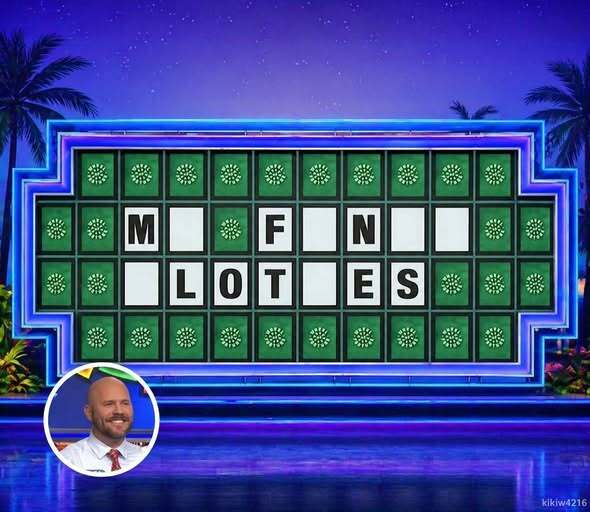
Adam Wredberg didn’t just play the game—he seemed to command it. From the very first spin, there was an almost magnetic confidence about him, as if the wheel itself had decided to cooperate. Each puzzle unfolded under his gaze with remarkable ease, letters revealing themselves like pieces of a story he already knew by heart. The audience could feel it building—an understated but undeniable sense of dominance, the kind that doesn’t need theatrics to make its presence known.
He never rushed. Never forced a moment. While others might have chased big risks or crumbled under pressure, Adam played with a quiet discipline that turned every turn into an advantage. His strategy wasn’t flashy, but it was relentless—small, precise decisions stacking one on top of another until his lead felt insurmountable. By the time he stepped into the Bonus Round, it didn’t feel like a question of if he would win, but how he would seal what already seemed destined.
And then came the moment that humbles even the best.
The Bonus Round—where certainty dissolves, and everything comes down to a single puzzle, ten fleeting seconds, and the weight of possibility. The board appeared, stripped down and unforgiving. The familiar rhythm he had mastered all night suddenly faltered. Letters that once seemed eager to fall into place now held back, forming a phrase that felt just within reach—close enough to touch, yet impossible to grasp.
Under the glare of the studio lights, with his family watching and the clock ticking louder with every passing second, Adam leaned in. He spoke. He guessed. He tried to will the answer into existence. But the words never quite aligned. They hovered at the edge of recognition, slipping away just as he reached for them.
Then—the buzzer.
Sharp. Final. Unforgiving.
In an instant, the energy in the room shifted. What had been building toward triumph dissolved into a quiet, collective ache. It was the kind of moment that lingers—not because of failure, but because of how close victory had been. Painfully close.
And that’s the truth at the heart of the game. Not perfection, not certainty—but the fragile intersection of preparation and chance. Adam Wredberg had done everything right. He had played brilliantly, nearly flawlessly. And yet, in the end, it all came down to one puzzle, one breath, one fleeting opportunity that slipped through his fingers.
It’s why the show endures. Because sometimes, even when everything points to victory, the outcome reminds us just how human the journey really is.