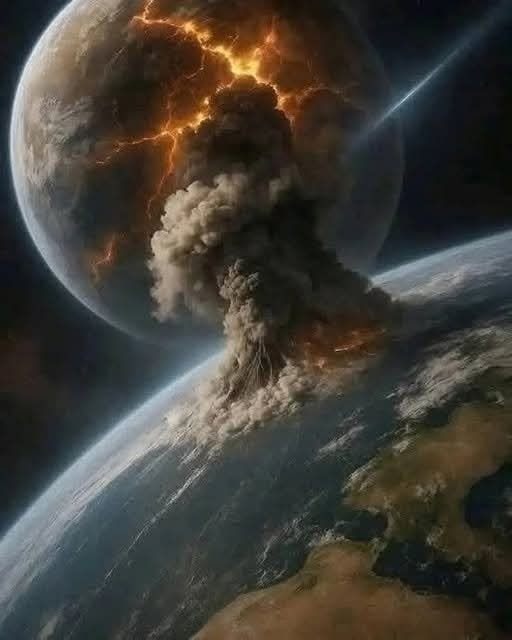
The warning didn’t arrive like a warning at all.
It came dressed in the polite language of certainty—folded into technical jargon, softened by reassurance, and tucked neatly between routine updates that scientists issue so often they begin to sound like background noise. Just another object. Just another flyby. Just another line item in the endless catalog of near-Earth statistics that rarely disturb anyone outside observatories and data centers.
At first glance, nothing about it demanded attention. The phrasing was calm, almost dismissive. Standard risk classification. Negligible probability. No cause for concern.
But then, almost quietly—almost carelessly—the real numbers surfaced.
Kilometers, not meters.
And something in that shift broke the rhythm of indifference.
Because “another rock passing by” belongs to a category the human mind can comfortably ignore. But a mountain-sized object moving through the silence of space, calculated with precision down to fractions of a second, begins to feel less like data and more like a truth we are not emotionally built to hold.
It has a designation that sounds more like a file name than a threat: 52768 (1998 OR2). A cold, bureaucratic label for something vast enough to reshape continents in a different timeline. Somewhere between roughly 1.5 and 4 kilometers wide, it drifts through the darkness with a kind of mechanical patience—no urgency, no intention, no awareness that anything is even there to be threatened.
And yet, on Earth, entire networks are devoted to following it.
Radiotelescopes and observatories quietly stitch together its trajectory. Supercomputers simulate its path forward through years, decades, sometimes centuries. Teams of scientists refine orbital predictions again and again, shaving uncertainty down to something almost poetic in its precision. Their conclusion is consistent, repeated, and confidently stated:
It will miss.
There will be no collision. No fracture of atmosphere. No incandescent streak tearing across the sky. No global night falling in a single catastrophic instant. Only a passing—a near miss measured in astronomical terms that feel both reassuring and strangely inadequate at the same time.
And still, its passage lingers in the imagination long after the data is filed away.
Because what it reveals is not fear, but fragility.
We live suspended in a narrow window of awareness, protected not by control, but by observation. Our defenses are not walls or shields, but telescopes, algorithms, funding cycles, international cooperation, and the fragile continuity of attention. We are safe only from what we manage to notice in time.
Today, the calculations are comforting. The models are stable. The trajectory is understood.
But somewhere beyond the next orbit, beyond the next report, beyond the next quiet press release, another object may already be moving—smaller, faster, darker, or simply unnoticed for longer than we would like to admit.
And that is the unsettling echo left behind by every official reassurance, every “no threat” declaration spoken in calm scientific tone:
Not whether we are safe today.
But how long that sentence will continue to be true.