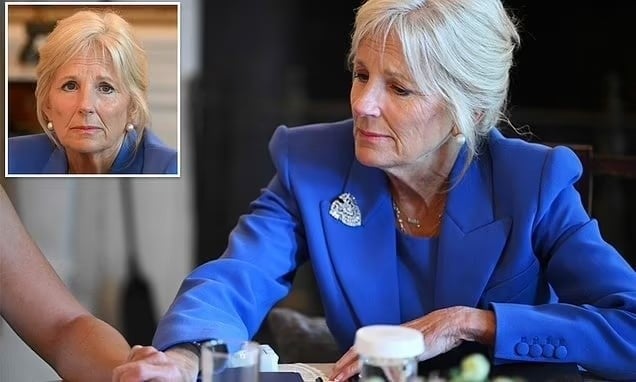
The room fell into a hushed stillness so complete it seemed to swallow the air itself. Conversations faded. Chairs creaked softly as people shifted forward. Then, before anyone could quite process what they had just witnessed, the silence cracked open—first with a ripple of applause, then with a wave that surged through the entire East Room.
History had just tilted.
For the first time in the nation’s history, a sitting First Lady—Jill Biden—had been sworn in as the United States’ next ambassador to a country fighting for its survival in the shadow of war. The moment carried a strange mix of solemnity and electricity. Tears glistened in the chandeliers’ light. Some aides clasped their hands. Others simply stared, as if unsure whether they had just witnessed a diplomatic appointment… or the beginning of something far more profound.
Across the ocean, the reaction was immediate—and explosive.
Russian state television erupted in fury, denouncing the move as political theater and provocation. Commentators shouted over each other as the news flashed across their screens. Meanwhile, in Kyiv, a single message appeared online from the office of Volodymyr Zelenskyy. It was brief, measured, and unmistakably pointed.
“Welcome, Madam Ambassador.”
Four words. Yet they carried the weight of artillery.
Within minutes, the message raced across the internet, amplified by diplomats, journalists, and ordinary citizens who understood what it signified. In a war defined by drones, missiles, and shattered cities, symbolism still mattered—and this symbol was thunderous.
Back in Washington, the official explanation sounded almost understated.
“A promise kept.”
But inside the capital’s political machinery, the appointment was being described with another word entirely: unprecedented.
Never before had the duties of America’s First Lady overlapped with the front lines of a global conflict. The role has always been powerful but unofficial—an institution shaped by tradition rather than law. From hosting dignitaries to championing social causes, First Ladies have long operated in a realm of influence without formal authority.
Now that boundary had shifted.
As ambassador to Ukraine, Jill Biden would not simply represent ceremonial goodwill. She would carry the diplomatic weight of the United States into one of the most volatile arenas on Earth. Every conversation, every handshake, every public appearance in Kyiv would echo with the policies of her husband, Joe Biden, and the strategic commitments of the White House.
But those who have followed her career closely insist the moment did not arrive out of nowhere.
Long before the headlines, there were the quiet trips.
When air-raid sirens wailed across Ukrainian cities, Jill Biden was already there—walking through schools converted into shelters, kneeling beside displaced mothers, and speaking with soldiers’ families whose lives had been fractured by invasion. At the time, those visits were described as symbolic acts of solidarity.
Now they look almost like rehearsals.
She moved through hospitals where windows were taped against shockwaves. She met teachers trying to rebuild classrooms after missile strikes. She listened to children describe nights spent in underground metro stations as bombs thundered above them.
It was diplomacy of a deeply human kind—less about treaties and more about presence.
And it left an impression.
When her nomination reached the Senate, many expected the usual partisan clash that greets almost any high-profile appointment in modern Washington. Instead, something unusual happened. Lawmakers from both parties found themselves praising the choice.
Foreign policy hawks argued that sending the First Lady to Kyiv signaled America’s unwavering commitment to Ukraine’s defense. Humanitarian advocates pointed to her decades of work in education and military family support as proof that she understood the emotional terrain of war just as well as its geopolitical stakes.
The confirmation sailed through with far less resistance than anyone predicted.
Yet the global reaction was anything but quiet.
In Moscow, the appointment was framed as escalation—a dramatic signal that Washington intended to deepen its involvement in the conflict sparked by Russian invasion of Ukraine. Commentators on state television accused the United States of staging “political theater,” suggesting that the move blurred the line between diplomacy and symbolism.
In European capitals, however, the mood was very different.
Diplomats privately described the appointment as a stabilizing gesture—a reminder that the United States was not stepping back from its commitment to Ukraine, even as the war dragged into years of attrition. Leaders across NATO quietly welcomed the message.
Kyiv, for its part, embraced it openly.
For Ukrainians, the presence of the American First Lady as ambassador felt less like spectacle and more like reassurance. It suggested that Washington saw their struggle not as a distant geopolitical contest, but as a living, breathing fight for democracy’s survival.
And in a war where morale can be as critical as ammunition, that kind of signal matters.
Yet perhaps the most revealing detail about Jill Biden’s new role came from a moment so ordinary it almost sounded absurd amid the drama of war.
She plans to keep grading papers.
For years, even after entering the White House, she continued teaching English at a community college—insisting that her identity as an educator mattered as much to her as any political title. Now aides say she intends to continue reviewing student assignments from a desk inside the U.S. embassy in Kyiv.
It’s a small act. But it sends a deliberate message.
This appointment, she insists, isn’t about grandeur or prestige.
It’s about work.
In a conflict defined by tanks, drones, and shattered infrastructure, the ambassador’s mission will be something quieter and far more intimate: helping a wounded democracy find its footing again. Supporting the rebuilding of schools and hospitals. Encouraging alliances that stretch beyond weapons and sanctions.
Standing beside a country learning—painfully, stubbornly—how to live again.
And when the applause in that Washington room finally faded, the realization settled in.
This wasn’t just a diplomatic posting.
It was a signal to the world that in the struggle unfolding across Ukraine, America had chosen not merely to watch history—but to place one of its most visible figures directly in its path. 🌍🇺🇸✨