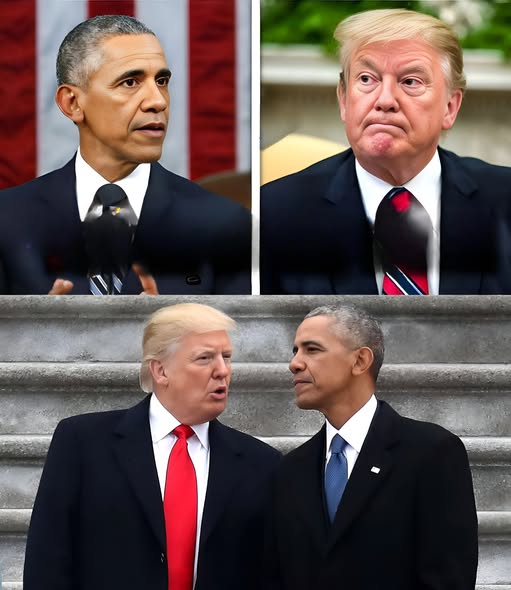
The shift was almost imperceptible at first—a tightening of tone, a pause that lingered just a second too long. Then it happened. The moment Donald Trump turned his focus squarely on Barack Obama, the air inside the studio seemed to drain away. What had begun as a routine, carefully managed interview suddenly hardened into something far less controlled—raw, personal, and impossible to ignore.
Viewers at home felt it instantly. The familiar rhythm of cable television gave way to tension you could almost touch. Words sharpened. Expressions shifted. The distance between political critique and personal confrontation collapsed in real time, unfolding not behind closed doors but on a national stage where every glance, every pause, every inflection carried weight.
Within minutes, the reaction spilled far beyond the studio walls. Screens lit up across the country as social media surged into motion, dissecting the exchange with relentless speed. Clips were clipped again, replayed, reframed, and reinterpreted. Hashtags multiplied. Opinions hardened. The country fractured into rival narratives, each side convinced they had witnessed the “true” meaning of the moment while the other was willfully blind.
What made the exchange so powerful wasn’t just what was said—it was how deliberately it seemed to be delivered. This was more than criticism; it was performance. A calculated move aimed not just at the interviewer or even at Obama himself, but at a vast, fragmented audience conditioned to consume conflict in real time. Supporters praised the bluntness, calling it honesty in a political culture they see as overly polished. Critics recoiled at the tone, seeing it as yet another erosion of civility and respect in public discourse. Meanwhile, millions hovered somewhere in between, replaying the footage, searching for subtext, motive, and meaning hidden between the lines.
But the deeper story isn’t confined to the exchange itself—it lives in what happened next. The moment revealed how seamlessly television and digital platforms now merge into a single, volatile ecosystem. A comment made in seconds can ignite hours—sometimes days—of reaction, debate, and distortion. Context struggles to keep up. Emotion races ahead. Outrage, in many cases, becomes the dominant currency.
In this environment, politics is no longer just about governance or ideology. It is about narrative control—who frames the moment, who amplifies it, and who ultimately defines how it is remembered. Leadership is judged not only by decisions made in office, but by performance under the unforgiving spotlight of constant visibility.
That interview, then, was not an anomaly. It was a glimpse into the mechanics of modern political theater—unfiltered, strategic, and relentlessly amplified. A reminder that in today’s hyperconnected world, the line between substance and spectacle is thinner than ever. And once crossed, it is nearly impossible to redraw.