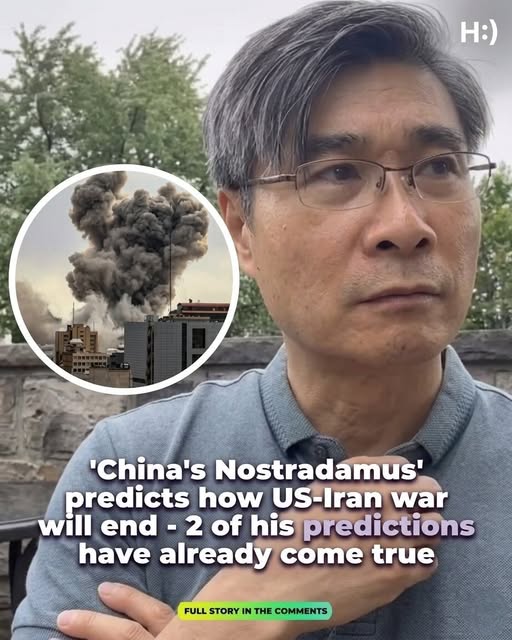
A quiet professor has just sent shockwaves across the internet—not with a dramatic speech, not with political theatrics, and certainly not with prophecy written in mysticism—but with something far more unsettling: cold, methodical logic.
There are no flashy headlines in his delivery, no emotional persuasion, no attempt to entertain. Yet his words are spreading faster than those of world leaders. Why? Because two of his earlier predictions—dismissed at the time as overly bold and even unrealistic—now appear disturbingly close to unfolding reality.
He had anticipated Donald Trump’s political resurgence long before it became a mainstream expectation. He also warned of escalating friction between the United States and Iran at a time when most analysts were still describing the relationship as “contained tension.” Now, as those developments begin to align with his forecast, attention has shifted sharply back to him.
And then comes his third claim—the one igniting the fiercest debate online.
According to him, the next major conflict involving the United States may not end the way history books have long assumed. Not a decisive triumph. Not a clean resolution. Possibly not even a clear definition of victory at all.
Some online have begun calling him the “Chinese Nostradamus.” Others reject the label entirely, arguing that his interpretations are too pessimistic, too deterministic, or too selective in reading global events. A few go further, warning that framing complex geopolitics as “predictions” can itself be misleading.
But Professor Xueqin Jiang never presents himself as a fortune-teller. He insists he is something far less mystical and far more uncomfortable: a pattern reader.
With a background in education and analysis, Jiang approaches global history like a repeating algorithm of pressure, response, and consequence. Empires rise, adapt, overextend, and collide with resistance they underestimate. In his framework, history is not a museum of isolated events—it is a warning system that keeps activating in new forms.
When he spoke in 2024, his three core arguments were met with skepticism. Yet as current events begin to echo pieces of his earlier reasoning, curiosity has shifted into concern, and concern into debate.
His most controversial assertion is not that conflict is inevitable, but that dominance is not guaranteed. He points to a recurring historical pattern: powerful states entering prolonged struggles with smaller, highly resilient opponents who understand terrain, timing, and endurance far better than expected.
In his view, Iran is not a sudden variable, but a long-prepared actor in a much longer game of attrition and strategy.
Whether Jiang ultimately proves insightful or incorrect remains to be seen. But his broader message is already resonating beyond academia: great powers often believe they are shaping history, when in reality, they are only participating in it.
And history, as he quietly suggests, does not rush its judgment.