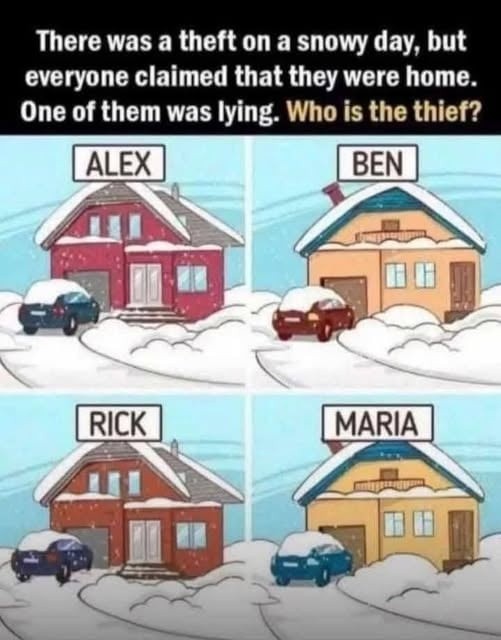
The blizzard arrived like a curtain call, swallowing the town whole—streets erased, rooftops softened into ghostly shapes, every sound muffled beneath a suffocating white silence. It was the kind of storm that made the world feel paused, suspended between moments, as if nothing could move, nothing could happen, nothing could be proven. And that was exactly what Ben had counted on.
By morning, the story was already set.
Four neighbors. Four houses standing shoulder to shoulder against the storm. Four identical statements delivered with eerie precision: We never stepped outside. We stayed in all night. The storm made sure of that. Their voices were calm, rehearsed without rehearsal, each word aligning too perfectly with the next. Together, they formed a seamless wall of denial—tidy, convincing, and, at first glance, unbreakable.
Inside, the town believed them. After all, who ventures out in a storm like that? Who risks the whiteout, the ice, the suffocating cold? The lie didn’t just sound reasonable—it sounded inevitable.
But outside, beyond the warmth of their carefully constructed alibis, the storm had been busy writing its own version of events.
The snow was no blank canvas. It was a record. A witness.
Driveways stretched out like quiet confessions beneath the pale winter light. Three of them lay untouched—smooth, pristine, undisturbed since the first heavy flakes had fallen. No footprints. No tire marks. No signs of life beyond the walls of those homes.
And then there was the fourth.
Ben’s driveway didn’t match the others. It couldn’t.
A pair of tire tracks cut through the snow like a scar—dark, undeniable, impossible to ignore. They curved out into the street and vanished into the whiteness beyond, a silent testimony etched in ice. Where the others had stillness, Ben had movement. Where they had absence, he had proof.
The storm hadn’t hidden anything. It had preserved it.
When the officers arrived, they didn’t need raised voices or aggressive questioning. They didn’t need contradictions or cracks in the story. They simply stepped outside and looked down.
Their boots followed the tracks slowly, deliberately, each step pressing into the same path Ben had taken hours before. What they traced wasn’t just rubber on snow—it was intent. A choice made under the false belief that nature would erase it. A quiet betrayal carried out under the illusion of invisibility.
Inside, Ben waited, confident at first, wrapped in the same calm certainty as his neighbors. The story was solid. The storm was on his side. Everything had been accounted for.
Until it wasn’t.
The moment they mentioned the driveway, something shifted. Not dramatically—no outburst, no sudden confession—but a subtle unraveling. His expression tightened, his composure thinning like ice under weight. He understood before they said another word.
The lie hadn’t failed because it was poorly told. It had failed because it had been told against something that didn’t lie back.
There was no need for further questions. No need for pressure. The evidence didn’t argue; it simply existed.
And just like that, the carefully constructed alibi—built on shared silence and mutual trust—collapsed under the simplest truth imaginable: snow remembers.
In a world that often buries the truth beneath layers of complexity, it wasn’t a clever interrogation or a dramatic revelation that broke the case. It was the quiet, unassuming clarity of a winter morning. A blank landscape. And the single, unmistakable mark that refused to disappear.