Speculation in Washington is accelerating into something closer to political anxiety, and at the center of it stands JD Vance — once confidently portrayed as the heir apparent to Donald Trump, now increasingly treated as a question mark rather than a successor.
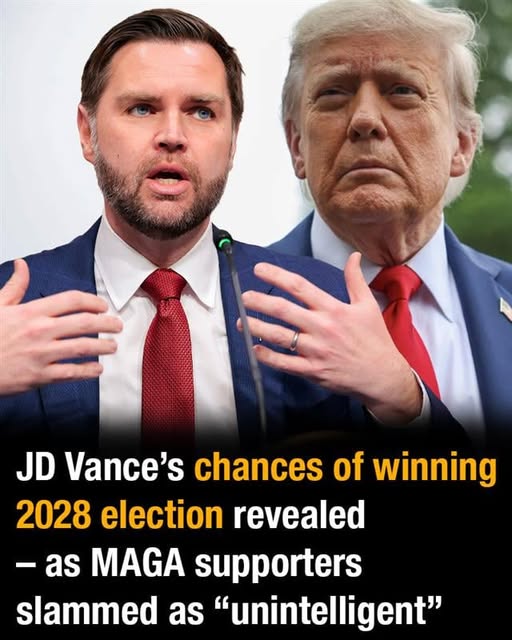
For months, Vance was framed inside Republican circles as the natural continuation of the Trump movement: a loyal vice president, a polished populist storyteller, and a figure young enough to carry the MAGA brand into a post-Trump era without losing its edge. At one point, prediction markets reflected that confidence, assigning him more than a 30 percent chance of winning the presidency in 2028. But that optimism has begun to erode. Across platforms like PredictIt and Kalshi, his odds have been swinging downward, chopped nearly in half in some trading windows — a volatile pattern that political observers increasingly interpret as a signal of deeper uncertainty rather than temporary fluctuation.
The backdrop to this shift is a Republican Party already bracing for life after Trump’s second and final term. In theory, succession should be straightforward. In practice, it is anything but. Trump’s political identity has become so dominant that it casts a long and distorting shadow over anyone positioned to follow him. Vance, once seen as the most seamless bridge between Trump’s base and a future generation of leadership, now finds himself navigating a landscape where loyalty alone may no longer be enough.
The pressure is not only coming from numbers on a screen, but from a rapidly intensifying cultural battlefield. High-profile critics and media personalities with enormous reach have begun openly challenging the MAGA movement’s identity and seriousness. Joe Rogan’s recent swipe at hardcore supporters — branding them “dorks” in a blunt and dismissive remark — reverberated far beyond podcast culture, cutting into the self-image of a movement that prides itself on authenticity and populist strength.
Vance’s response, blending humor with firm defense of his political base, demonstrated his instinct for rapid-fire political damage control. Yet it also underscored the delicacy of his position. Every public exchange now carries double weight: it is not just about the moment, but about whether he can sustain credibility in a party that is already beginning to fracture into competing visions of what comes next.
Behind the polling swings, podcast commentary, and prediction-market volatility lies a more fundamental tension. Trump’s influence is still the gravitational center of Republican politics, and stepping out from that orbit without losing momentum may prove to be the defining challenge of Vance’s political future. The question is no longer simply whether he can inherit the movement — but whether the movement, once Trump is gone, will remain unified enough for anyone to inherit at all.