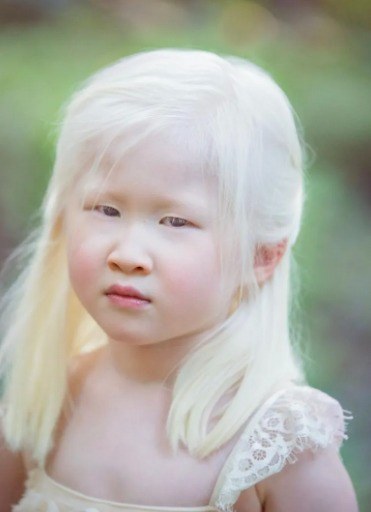
Born unwanted, she entered the world like a secret someone was desperate to hide. Left at the door of an orphanage, with no goodbye and no explanation, she was another quiet casualty of fear—of difference, of superstition, of a condition too often misunderstood. In many places, children with albinism are not just rejected; they are hunted, whispered about, treated as omens rather than human beings. She could have vanished into that silence, her story ending before it ever truly began.
But it didn’t.
Years later, that same child would stare back from the glossy pages of Vogue, her pale skin glowing under studio lights, her gaze unflinching, impossible to ignore. The world that once turned away was now forced to look—and to reckon with what it had tried to erase.
Between those two moments lies a journey carved through danger, displacement, and defiance.
Abandoned because of her albinism, Xueli Abbing’s life could have been defined by loss. Instead, it was rewritten by love. Adopted by a Dutch family who saw not a burden, but a rare and extraordinary child, she was given more than a home—she was given a new way to see herself. They called her “snow-white beauty,” not as a label, but as a truth. In a world that had tried to convince her she was less, they taught her she was unique. Not broken, but rare. Not cursed, but powerful.
Still, the world beyond her home was slower to change.
Fashion, for all its claims of creativity, had long drawn narrow lines around beauty—lines that excluded faces like hers. For years, people with albinism were either erased or reduced to stereotypes, their stories untold, their presence overlooked. So when a designer approached Xueli with an idea centered on “perfect imperfections,” it wasn’t just an invitation. It was a disruption.
Stepping in front of the camera, Xueli didn’t just pose—she challenged an industry.
When she appeared in Vogue Italia, it wasn’t merely a career milestone. It was a statement. The girl once hidden away was now impossible to ignore, her image traveling across borders, reshaping conversations about beauty, identity, and worth. She wasn’t there to fit into fashion’s old definitions—she was there to expand them.
Now a teenager, Xueli understands something deeper than fame.
Visibility, she knows, is not just about being seen—it’s about being understood.
She uses her platform not to celebrate herself alone, but to speak for those still living in fear, in places where albinism can still mean danger or death. She challenges the words people use, insisting on language that respects dignity rather than feeding myth. She reminds the world that behind every label is a human being with a voice, a story, and a future.
And perhaps the most powerful twist in her journey isn’t that she became famous.
It’s what she discovered along the way.
Beauty, she realized, was never something the world could give—or take away. It wasn’t in the approval of others, nor in the narrow standards of an industry. It lived somewhere deeper: in resilience, in identity, in the courage to exist unapologetically in a world that once tried to erase you.
The girl who was abandoned as a secret has become a voice that cannot be silenced.
What was once seen as a curse has become her light.
And now, she shines it back on the world—forcing it to see not just her, but everyone it has ever tried to hide.