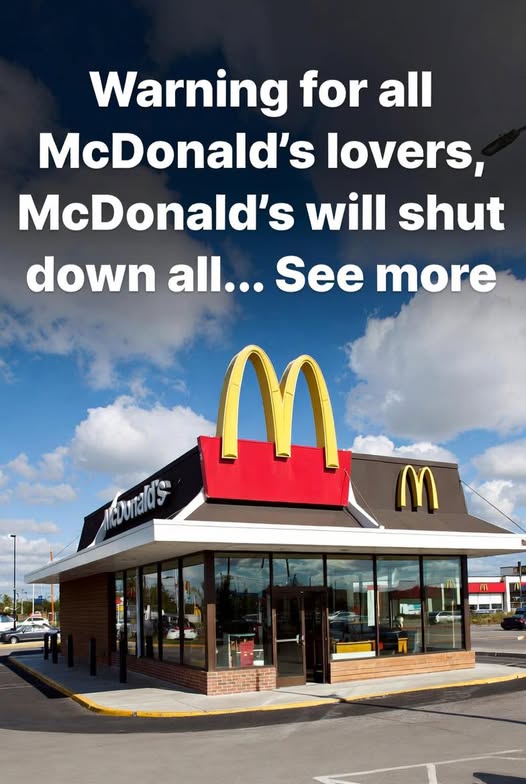
The doors are gone.
Where there was once a threshold—a clear signal of entry, of permission, of transition—there is now only open space. The building stands exposed, unguarded, impossible to overlook. In a move that feels both subtle and seismic, McDonald’s has transformed something as ordinary as an entrance into a striking cultural statement. No announcement, no spectacle—just the quiet removal of doors, and suddenly, people can’t stop talking.
At first glance, it might seem like a clever design tweak, a minimalist gesture. But the reaction tells a different story. This isn’t just architecture; it’s symbolism. It raises an uneasy question: is this radical transparency, a bold evolution of brand identity—or the beginning of something more unsettling? What starts as a physical change quickly spirals into a deeper conversation about safety, boundaries, and the lengths brands will go to command attention in a world that never pauses, never disconnects, never truly closes.
Because doors have always meant more than function. They mark a boundary. They offer a sense of control, of separation between inside and outside, open and closed, welcome and not now. By stripping them away in select 24/7 locations, McDonald’s isn’t just making a statement about convenience—it’s reshaping the emotional agreement between itself and its customers.
An open entrance suggests trust. It signals that you’re welcome at any hour, that the lights are always on, that access is effortless and guaranteed. There’s something comforting in that promise. But at the same time, something essential disappears: the quiet reassurance of closure. The simple, familiar moment when a locked door tells you the day is done. That it’s okay to stop.
Without that signal, the experience shifts. The space feels different—more exposed, less defined. And that absence lingers in a way no traditional advertising ever could. It unsettles, precisely because it removes something we didn’t realize we relied on.
In a culture increasingly obsessed with frictionless living—instant access, constant availability, zero barriers—the doorless restaurant becomes both an invitation and a warning. It promises a world where you’re never turned away, where there’s no such thing as “closed,” no interruption to the flow. But it also hints at a future where nothing powers down, where the distinction between public and private dissolves, and where the idea of stepping away becomes harder to grasp.
McDonald’s may have removed a piece of hardware. But in doing so, it has quietly dismantled something far more profound: our sense that some boundaries still exist—that some thresholds still matter, and that somewhere, somehow, there are still doors we can close.