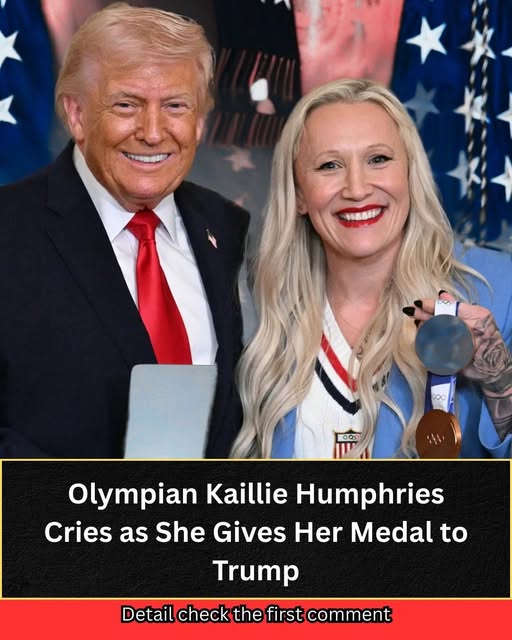
President Donald Trump stood frozen for a moment, an Olympic medal resting in his hands, as if the weight of it carried more than gold. The room held its breath. Then, the athlete before him — voice quivering with emotion — thanked him for changing the course of her family’s life. In that charged East Room, a single gesture, a single medal, transformed into something far larger: a collision of personal triumph, political conviction, and the raw emotion of a country divided. Some spectators saw courage; others saw betrayal. And behind the applause and the flashbulbs, the story that unfolded was anything but simple. Between IVF journeys, immigration struggles, and heated debates over who can compete in women’s sports, Kaillie Humphries’ words became a lightning rod, igniting conversation across the nation.
Humphries, the Canadian-born bobsled champion who had become a U.S. citizen and a two-time Olympic bronze medalist for Team USA, chose her most intimate battle to honor one of the most polarizing figures in American politics. Standing tall yet visibly moved, she recounted her 2.5-year struggle with IVF, the painstaking path to motherhood that had tested her resolve, her body, and her faith. She framed herself as a “legal immigrant,” a symbol of perseverance and opportunity, and credited Trump’s policies with providing families like hers the chance to grow. Then, in an unprecedented move, she handed the president the Order of Ikkos — a medal typically reserved for the silent, unseen coaches and mentors who guide athletes to victory. It was a moment that blurred lines between gratitude, politics, and spectacle.
Her speech, while deeply personal, was also pointedly political. She praised Trump for “keeping biological women in women’s sports” and for expanding access to IVF treatments, aligning herself publicly with policies that have sparked fierce national debate. At the same time, those same executive orders restricted transgender women from competing and pushed federal agencies to reduce fertility treatment costs — moves that have drawn both admiration and sharp criticism. In that single act, Humphries fused motherhood, patriotism, and exclusionary policy into a tableau of American division, crystallizing the new front lines of the culture wars: who is protected, who is left out, and who gets the honor of shaping the rules that govern both.
By the end of the ceremony, the applause was thunderous, but the conversation had already begun outside the East Room: debates over gender, family, and power were reignited, all because a bobsledder handed a medal to a president — a gesture simple in form but seismic in consequence.