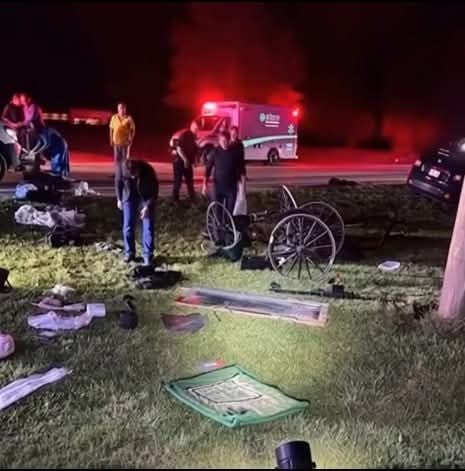
Screams ripped through the quiet Indiana night, shattering the calm of rolling fields and lantern-lit homes. What should have been a tranquil buggy ride through the countryside—an ordinary journey home for an Amish family—turned in an instant into a scene of chaos and horror. Twisted splinters of wood, the blare of flashing headlights, and the scattered cries of children littered the cold asphalt as the world around them erupted into violent motion. In the rural no-man’s-land near Berne, a Jeep, roaring down a road meant for speed and steel, collided with a family out of time, their horse-drawn buggy no match for modern machinery.
On State Road 218, the collision transformed a stretch of serene farmland into a makeshift emergency scene. Nine Amish passengers had been riding quietly under the stars when the impact sent them flying, their carriage shattered like fragile glass. Seven people were injured, most of them children, their peaceful ride replaced by the frantic roar of helicopter blades slicing through the darkness, sirens screaming, and floodlights cutting stark, unnatural shapes across the scene. The calm of the night had been replaced by fear, confusion, and the urgency of survival.
Investigators comb through the wreckage, running tests on the Jeep driver’s blood, but the questions that haunt the community go far deeper than liability or cause. How can delicate wooden buggies endure on roads built for armored vehicles and racing speeds? How can a centuries-old way of life survive in a world that moves so fast it often cannot see them? For the Amish families here, this is not merely an accident report to be filed and forgotten—it is a stark reminder of the precarious balance between tradition and modernity. Every journey after dark, every curve and straightaway on these rural roads, is now haunted by the memory of one violent moment when the speed of the modern world collided with a way of life that moves slower, steadier, and always with care.
The air still smells of splintered wood and burned rubber, and the echo of terrified voices lingers in the fields. In Berne, life must go on, but the memory of this night—a night when horses and humans were overtaken by the relentless pace of modern machines—will never fade.