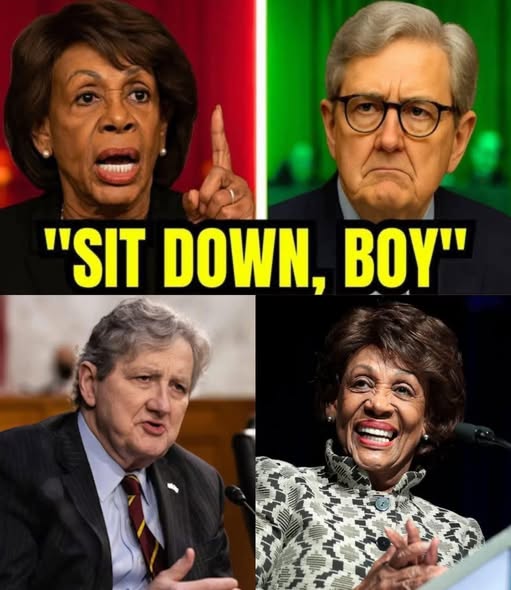
The room didn’t simply fall silent—it fractured. The air itself seemed to split under the weight of what had just been said. One command, sharp and unyielding, just three syllables long, tore through the space like a fault line finally giving way. In an instant, everything shifted. Conversations died mid-breath. Staffers froze, eyes darting but bodies locked in place. Cameras leaned forward as if they, too, could sense history tightening its grip on the moment. It wasn’t just tension—it was rupture. The kind that reveals what had always been there, buried beneath decorum and rehearsed civility.
And at the center of it all sat John Kennedy.
For a heartbeat—maybe two—he didn’t move. The words hung in the air, heavy and electric, refusing to settle. Then, slowly, deliberately, he reached up and removed his glasses. It was a small gesture, almost ordinary. But in that moment, it felt like a decision. A line being drawn—not in anger, but in control. He looked up, steady and unflinching, and chose his response with the kind of care that only comes when the stakes are understood in full.
He didn’t snap back. He didn’t raise his voice. He didn’t reach for the easy weapons—sarcasm, indignation, the sharp-edged theater that so often dominates these exchanges. Instead, he let the insult breathe. He allowed it to exist in the space without immediately trying to crush it. And then, when he finally spoke, his words came measured, almost disarmingly calm. Not weak. Not passive. But intentional.
It was a refusal—quiet but unmistakable.
He would not accept the label placed on him. But just as importantly, he would not become the reaction that label was designed to provoke. In a political culture that feeds on escalation, that rewards the loudest outrage and the quickest retaliation, his restraint became something rarer than defiance—it became strategy. By refusing to ignite the moment, he denied it the spectacle it demanded. He shifted the frame entirely. No longer was he simply a man being addressed or diminished. He became the one deciding how the moment would be remembered—and how he himself would be seen.
Across the room, the words from Maxine Waters still echoed. They didn’t fade; they traveled. Beyond the walls, beyond the cameras, they rippled outward into a country already primed to interpret, to divide, to choose sides. Almost instantly, the moment transformed into something larger than the people in it. It became a mirror.
For some, her words carried the force of long-suppressed frustration—truth spoken plainly, without apology. For others, they crossed a line, an unforgivable breach of respect in a space that demands at least the appearance of civility. The debate wasn’t just about what was said. It was about what it meant—and what it revealed about power, about race, about gender, about who is allowed to speak with force and who is expected to absorb it.
But as the moment replayed—again and again, on screens large and small—something unexpected began to take hold.
It wasn’t just her words that lingered.
It was his response.
In a culture addicted to the explosive, where every confrontation is expected to crescendo into chaos, Kennedy’s restraint felt almost subversive. It forced a different kind of attention. A quieter, more uncomfortable kind. Because without the distraction of a shouting match, there was nowhere for the audience to hide. No easy narrative to cling to. Just a choice: what did they value more—force or control, reaction or intention?
In the end, the room didn’t just witness a clash. It witnessed a decision.
Not about who was right or wrong—but about how power can be expressed, withheld, and redefined in the span of a single, fragile moment.