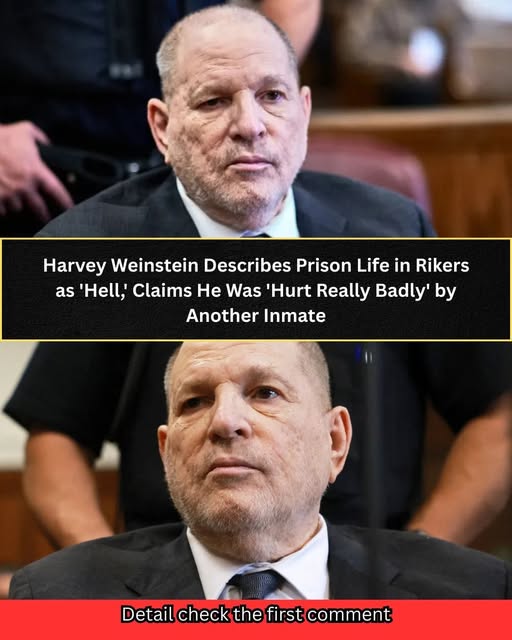
Wealth once bought him influence. Power once opened every door in Hollywood. For decades, few people could imagine a world where Harvey Weinstein would find himself powerless. Yet now the once-untouchable film titan says he is trapped in a place he calls nothing short of “hell.” Inside the harsh confines of Rikers Island, he is pleading for a transfer out of the notorious New York jail and into a state prison, claiming that every day there feels like a fight simply to survive.
According to Weinstein, the world around him has collapsed into something bleak and suffocating — a narrow existence defined by cold concrete walls, clanging metal doors, and an atmosphere thick with suspicion. Gone are the luxury offices, red carpets, and studio meetings that once shaped his life. In their place, he describes a routine ruled by guards, medical checks, and the relentless tension of being one of the most recognizable — and reviled — inmates in the facility.
He says the danger is constant.
Weinstein claims that during one recent confrontation he was punched in the face simply for asking another inmate about access to a phone. The blow, he alleges, left him bleeding on the floor while others watched. Yet even in that moment, he says fear kept him silent. Naming his attacker could mean being branded a snitch — a label that, inside a jail like Rikers, can carry consequences far worse than the initial violence. In a place where reputation can be the difference between survival and vulnerability, silence becomes its own form of self-protection.
Isolation, he now argues, has become his only refuge.
The former movie mogul says he spends most of his time separated from the general jail population, confined largely to his cell. The isolation is both protection and punishment: safety from potential attacks, but also a lonely existence where hours stretch endlessly and human interaction becomes rare. He claims other inmates see him not as just another prisoner, but as an opportunity — someone whose notoriety and former wealth make him a target for intimidation, extortion, or leverage.
In his telling, survival inside the jail requires constant calculation: who to speak to, what to say, and how much attention to attract. Every conversation could carry risk. Every glance might be misread. In that environment, Weinstein says he has learned that the safest place is often alone.
But beyond the walls of Rikers Island, the narrative shifts dramatically.
Outside, public sympathy is scarce.
Weinstein’s imprisonment stems from the convictions that followed a cascade of accusations from women who said they were abused, harassed, or assaulted during the years when his power dominated Hollywood. Those testimonies became some of the most visible sparks of the global #MeToo movement, a reckoning that forced industries worldwide to confront how power, silence, and intimidation had long shielded predatory behavior.
The courtroom battles that followed reshaped Weinstein’s legacy forever.
Once known as the co-founder of Miramax and the driving force behind dozens of award-winning films, his name became synonymous with the very abuses the movement sought to expose. Convictions in both New York and California sealed his fall from power, marking one of the most dramatic reversals of fortune in modern entertainment history.
Now, as Weinstein’s lawyers push for transfers, appeals, and expanded medical treatment following his leukemia diagnosis, his claims of suffering inside jail collide with a public memory that remains sharp and unyielding.
For many people, the focus is not the discomfort of his current confinement, but the years of alleged harm that preceded it — the stories told by women who said they were silenced, threatened, or ignored while his influence remained unchecked.
Inside the jail, Weinstein says he fears he may not survive.
Outside, however, the conversation has moved beyond his personal hardship. For supporters of the #MeToo movement, his imprisonment represents something larger — a rare moment when extraordinary wealth and influence failed to shield someone from accountability.
And that contrast defines the strange final chapter of his story.
Within the gray corridors of Rikers Island, he describes a daily struggle filled with fear, isolation, and physical vulnerability. But beyond those walls, the world sees something very different: not a fallen mogul trapped in hell, but a symbol of a cultural shift — a moment when power no longer guaranteed protection from the consequences of abuse.