Oil prices are surging. Cargo ships are idling in tense silence. And in one of the most strategically dangerous waterways on Earth, the temperature of global politics is rising by the hour. In the narrow passage of the Strait of Hormuz, a crisis that once seemed distant is now threatening to spill into a full-scale international confrontation.
Iran’s latest moves have turned this vital corridor into a pressure point for the entire world. Reports of naval mines being deployed, warnings issued to oil tankers, and increasingly aggressive rhetoric have transformed the strait from a shipping route into a potential flashpoint. Tankers hesitate to move. Insurance costs skyrocket. Every captain navigating those waters now knows that a single mistake, a single explosion, could trigger something far bigger than a maritime incident.
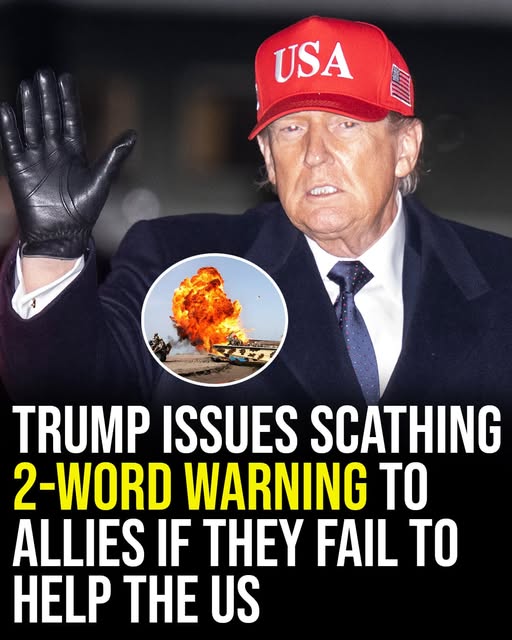
At the center of the storm stands Donald Trump, who has issued a blunt and unmistakable warning to the world’s most powerful alliances. If global powers fail to act, he suggests, the consequences could be severe. His message was directed not only at longtime Western allies but also at rising powers like China, whose economy depends heavily on the uninterrupted flow of Middle Eastern oil. Trump’s challenge is clear: the crisis in Hormuz is no longer just America’s problem.
Meanwhile, the numbers alone reveal how fragile the situation has become. More than a thousand oil tankers are reportedly stalled or rerouting near the strait, while crude prices surge past the psychologically important $100-per-barrel mark. For consumers thousands of miles away, the consequences are already creeping into everyday life. Higher oil prices ripple through economies, raising fuel costs, increasing transportation expenses, and pushing inflation higher in countries already struggling with economic uncertainty.
Iran’s partial closure of the strait, reinforced by the alleged deployment of sea mines and warnings against vessels linked to the United States, has effectively turned one of the world’s most critical energy arteries into a geopolitical chessboard. Nearly a fifth of the planet’s oil supply normally passes through this narrow stretch of water. Disrupt it, and the entire global economy feels the shock.
The crisis also exposes deeper tensions among international alliances. Trump’s remarks carry a sharp edge when directed toward NATO, reminding European nations of the support Washington has provided in conflicts such as the war involving Ukraine. His argument is pointed: if the United States has stepped forward to defend European security, will Europe now stand firmly with Washington as a new threat emerges in the Persian Gulf?
At the same time, Beijing watches carefully. As the world’s largest importer of oil, China has a massive stake in keeping the strait open. Yet its response could reshape global power dynamics. Cooperation might stabilize the crisis. Hesitation could deepen it.
Behind the diplomatic statements lies a darker possibility. Trump’s hints about potential strikes on Iranian oil infrastructure raise the chilling prospect that the next phase of this standoff may not unfold at negotiating tables. Instead, it could erupt in the skies and waters of the Middle East, where warships, aircraft, and mines sit uncomfortably close together.
History shows how easily tensions in the Persian Gulf can spiral. A misinterpreted radar signal, a drifting mine, or a warning shot gone wrong could ignite a confrontation that pulls multiple powers into the conflict within hours.
For now, the world watches the narrow waters of Hormuz with growing unease. Oil markets tremble. Governments hold urgent meetings. And every tanker captain crossing that chokepoint knows the truth: the line between economic disruption and military conflict has never been thinner. 🌍⚠️🛢️