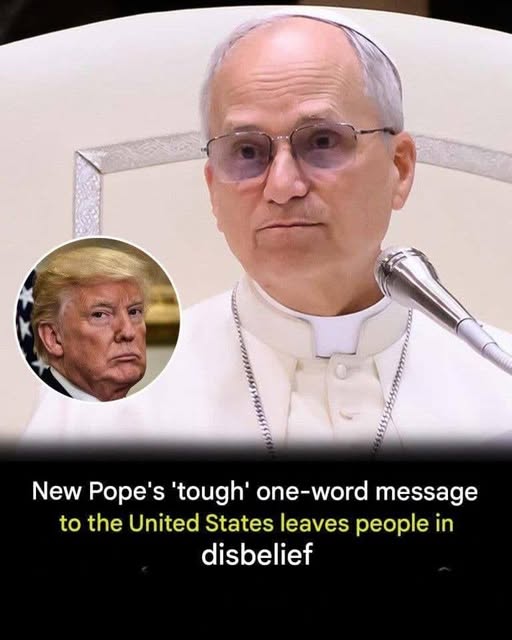
The press room fell into an uneasy silence, the kind that makes the air itself seem to hold its breath. No one knew immediately why. A thousand cameras whirred, flashes popped, and journalists leaned forward, pens poised, mouths slightly open—but all of it froze in an instant. One question had been asked. One breath had been drawn. One word, delivered with the quiet authority only a pope could summon, sliced through the room like a blade. And in that word, an entire nation felt its exposed heart.
There were no speeches. No political platitudes. No comforting blessing to soften the blow. Just a single, devastating word, uttered by the first American ever to occupy the Chair of Peter, carrying the weight of centuries, of conscience, of judgment: “Repent.”
The word hung in the room, vibrating with an almost physical intensity. Cameras clicked relentlessly, journalists shouted urgent follow-ups, their voices bouncing off the high ceilings like echoes in a cathedral—but Pope Leo XIV said nothing more. He folded his hands, his face a study in controlled sorrow and quiet, unyielding resolve. He did not need to explain; the word alone was enough.
The world had given him a stage to praise, to flatter, to bask in the pride of his homeland. He could have offered words of celebration, of unity, of hope. Instead, he chose something far heavier: a challenge, a mirror, a call to conscience. “Repent” was not a sermon aimed at politics. It was a moral verdict on a culture that had grown complacent, distracted, and self-absorbed.
In that single syllable lay a universe of meaning. It spoke to the violence that stained the streets, to the greed that hoarded wealth while others went hungry, to the subtle indifference that let human suffering pass unnoticed. It reached into the curated lives of a society obsessed with image and noise, exposing the quiet despair and the unacknowledged emptiness beneath.
With one word, Pope Leo XIV refused to coddle the nation that had raised him. He did not seek applause, nor comfort, nor agreement. He demanded reflection, accountability, transformation. He called not for pride or progress, but for a painful, necessary turning of hearts—a reckoning that every soul in that room, and every soul listening across the globe, could feel pressing down upon them.
It was a moment that would not be forgotten. A moment when history seemed to pause, watching as an American pope, with nothing more than a single word, reached through centuries of rhetoric and self-deception to speak directly to the soul of his nation.