Democrats didn’t see this coming.
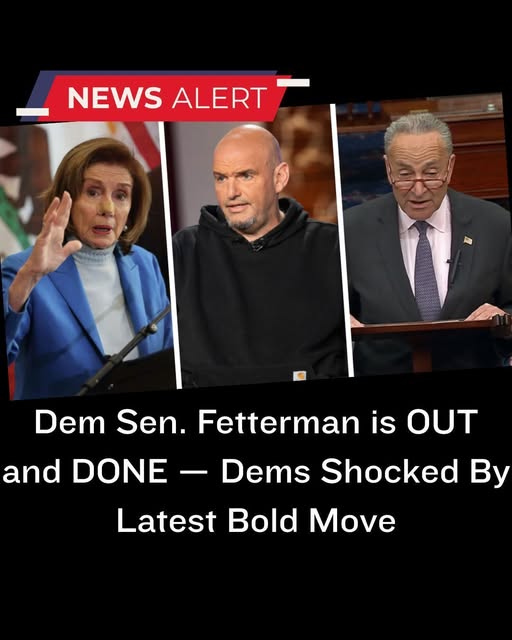
In a single, unscripted moment, Senator John Fetterman cracked open one of his party’s most protected narratives — and the shockwaves are still spreading across Washington. During a high-profile interview, he openly challenged Senate Majority Leader Chuck Schumer’s comparison of new voting laws to “Jim Crow 2.0,” a phrase that has become a rallying cry for many Democrats. Instead of echoing the party line, Fetterman did something far more disruptive: he sided with the overwhelming majority of Americans — 84% in some polls — who say requiring voter ID is simply common sense.
That single admission may prove more consequential than it first appeared.
By rejecting the “Jim Crow 2.0” label and acknowledging that showing identification to vote is “not a radical idea,” Fetterman exposed a widening gap between Democratic messaging and public opinion. For years, the party has framed voter ID requirements as inherently suppressive. But broad bipartisan polling consistently shows strong support for such measures, including among minority and working-class voters. Fetterman’s comments didn’t just deviate from party orthodoxy — they spotlighted how disconnected that orthodoxy may have become.
And this isn’t happening in a vacuum.
The debate is unfolding alongside renewed Republican momentum behind the Safeguard American Voter Eligibility Act (SAVE Act), a bill aimed at tightening voter eligibility verification. Supporters argue it’s a straightforward effort to safeguard election integrity; critics warn it could create new barriers to voting. At the same time, former President Donald Trump has amplified concerns about election security and border enforcement, further intensifying the political pressure.
Within the Senate, Republicans have hinted at reviving an old-school, talking filibuster — forcing senators to physically hold the floor — to dramatize the issue and put Democrats on record. It’s a high-stakes strategy designed to turn procedure into spectacle. Democrats, for their part, remain firmly opposed, effectively ensuring the bill’s demise in its current form despite rising voter frustration over election integrity and border control.
The result is a political standoff that feels bigger than one bill.
Fetterman’s break isn’t just a messaging glitch; it’s a cultural warning shot. It reflects a deeper tension inside the Democratic coalition: a progressive base that demands ideological purity versus a broader electorate that increasingly prioritizes pragmatic assurances — proof of citizenship, secure borders, and transparent elections. His comments suggest that clinging to maximalist rhetoric may no longer be sustainable in a political environment where trust in institutions is fragile and voters want tangible safeguards.
Caught at the crossroads of election reform, immigration debates, and the looming threat of government shutdown battles, Fetterman has unexpectedly become a symbol of something larger. Not a party defector. Not a Republican ally. But a Democrat willing to admit that the public mood is shifting — and that pretending otherwise may carry its own political cost.
Whether this moment marks the beginning of a broader recalibration or just another flashpoint in America’s endless partisan war remains to be seen. But one thing is clear: the script is no longer holding. And when a senator from within the ranks says the quiet part out loud, it’s not just a headline — it’s a warning.