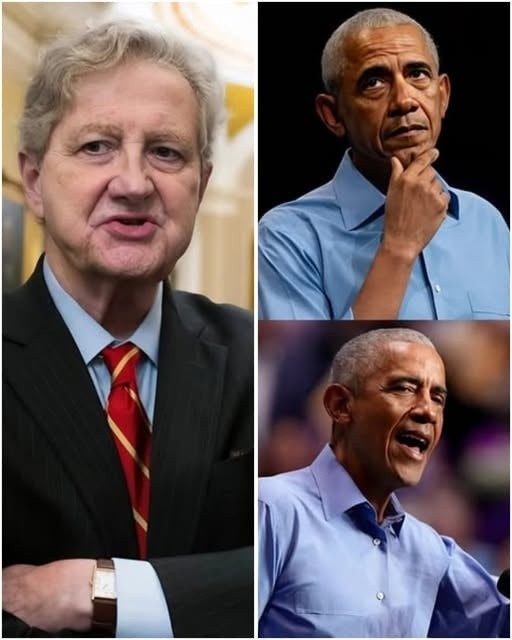
A fierce political controversy ignited this week when John Kennedy publicly called on Barack Obama to return what he described as one hundred twenty million dollars allegedly tied to the passage of the Affordable Care Act. The accusation, delivered with a tone that blended legal formality and moral urgency, immediately set off a chain reaction across cable news networks, political talk shows, and the endlessly reactive landscape of social media.
Kennedy did not present his demand as a routine partisan critique. Instead, he framed it as a matter of ethical accountability, suggesting that the former president may have personally benefited from legislation he once championed as a cornerstone of public service. Whether substantiated or not, the allegation was crafted in a way that cuts straight to the core of public sensitivity—trust in leadership. In modern political discourse, few accusations carry more weight than the idea that elected officials might exploit their positions for personal gain.
Yet, the real power of the claim lies less in its factual grounding and more in the chain reaction it unleashes. Allegations of corruption operate differently from ordinary political disagreements. They bypass careful analysis and ignite immediate emotional responses—anger, suspicion, and tribal loyalty. In today’s media environment, outrage spreads at a velocity that far outpaces verification. Facts arrive later, often drowned out by the initial wave of reaction, while nuance struggles to survive in a system optimized for speed and amplification.
Kennedy’s rhetoric reflects a calculated balance. His words were measured, almost procedural in tone, giving the impression of a formal grievance rather than a political attack. But beneath that restraint sat a far more explosive implication: not just potential misconduct, but a profound betrayal of public trust by a figure who remains one of the most recognizable and symbolically significant leaders in recent American history.
The result is a narrative that extends beyond a single accusation. It becomes a case study in how modern political conflict operates—where perception can rival reality, where allegations become catalysts, and where the battle for public belief often unfolds long before the truth has a chance to fully emerge.