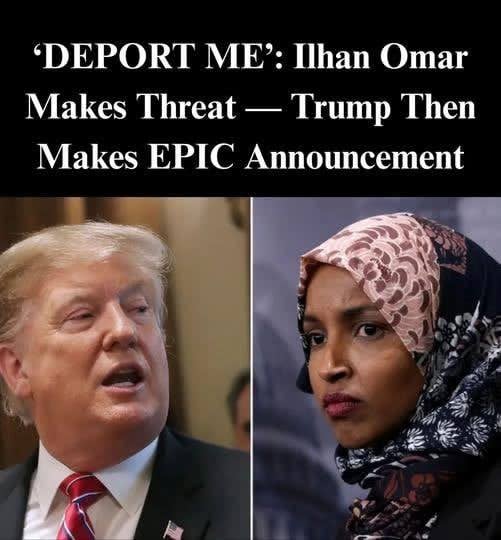
The nation’s political climate reached a new boiling point this week after Representative Ilhan Omar ignited fresh controversy with a bold and defiant public statement—one that critics were quick to seize upon and frame as a direct challenge to immigration enforcement under former President Donald Trump. Known for her sharp critiques of Trump-era immigration policies, Omar employed fiery, uncompromising language that immediately set off alarms across conservative media outlets and political circles. To her supporters, the remarks were largely symbolic, a deliberate attempt to draw attention to what she views as systemic injustice and the human cost of aggressive enforcement. To her opponents, however, the statement appeared calculated to provoke outrage at a time when the national conversation around borders, executive authority, and enforcement is already dangerously polarized.
The response from Trump came swiftly. Within hours, he countered with what allies enthusiastically labeled an “epic announcement,” strategically using the moment to reassert his hardline approach to immigration and border security. The announcement was framed as a show of strength and resolve—a signal that the administration would not bend in the face of rhetorical challenges from political adversaries. Leaning heavily into law-and-order themes, Trump reiterated his commitment to stricter enforcement and tighter controls, drawing enthusiastic applause from supporters who view such firmness as both necessary and overdue. Critics, meanwhile, cautioned that the escalating tone on both sides risks further entrenching divisions and diverting attention from realistic, bipartisan policy solutions.
What began as a single statement quickly evolved into a broader national reckoning over free speech, political symbolism, and the boundaries of provocation in an era of hyper-partisanship. Defenders of Omar argue that her words reflect deep-seated frustration shared by immigrant communities and advocacy groups who believe enforcement practices have crossed moral and constitutional lines. Her detractors counter that such rhetoric undermines respect for the rule of law and inflames public sentiment without offering viable alternatives. As the debate spilled across social media platforms and dominated cable news panels, the focus shifted away from the original remarks and toward two fundamentally different visions of America’s immigration future.
As reactions continue to ripple through Washington and beyond, the episode serves as a stark reminder of how rapidly modern politics can transform a few sentences into a national flashpoint. Whether Trump’s announcement ultimately results in meaningful policy shifts or simply adds another dramatic chapter to an ongoing political rivalry remains uncertain. What is unmistakable, however, is that the confrontation has energized both political bases, hardened partisan narratives, and ensured that immigration will remain one of the most volatile and defining issues as the country moves deeper into the next phase of the political cycle.