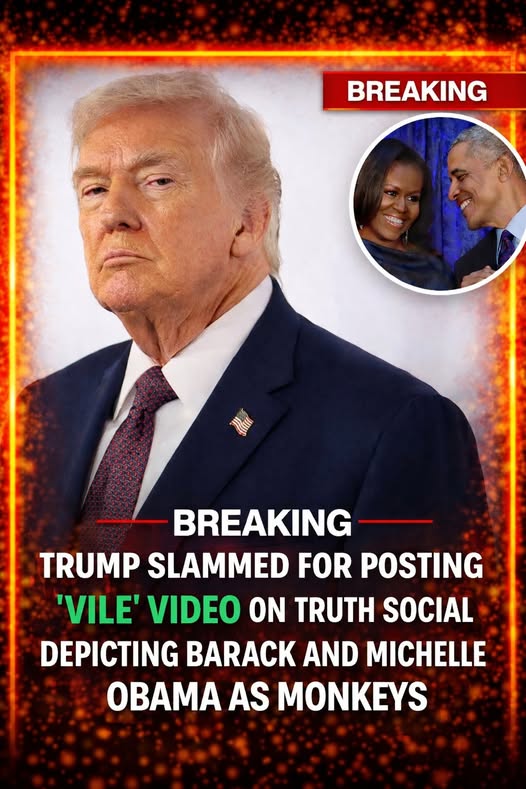
Trump’s post landed like a punch to the gut—sudden, brutal, and impossible to shrug off. In the span of seconds, a single crude meme ricocheted across social media, dragging America’s first Black First Family into a spectacle of racist humiliation. Shock quickly curdled into fury. Even some of Trump’s former supporters recoiled, calling it “a new low, somehow lower than the last,” while the White House brushed it aside as harmless humor. In that moment, the already-frayed line between internet trolling and moral decay finally snapped.
The outrage surrounding Donald Trump’s Truth Social post wasn’t just about yet another offensive meme in an endless stream of provocation. It struck a far deeper nerve, reviving one of the oldest and ugliest racist tropes in American history. Cloaked in so-called “jungle” jokes and Lion King references, the post targeted Barack and Michelle Obama in a way that felt calculated rather than careless. For many watching, this wasn’t politics as usual—it was a deliberate act of dehumanization, broadcast loudly from the center of a presidential campaign and amplified by millions within minutes.
What made the moment even more unsettling was the stark divide in how it was received. Some users, including people who once voted for Trump, spoke out publicly with shame and regret, saying this crossed a line they could no longer rationalize or defend. Others cheered him on, ignoring the racial subtext entirely and fixating instead on election-fraud claims, waving off criticism as “fake outrage” or oversensitivity. Between those two reactions lies a nation worn down by cruelty, trapped in a cycle of outrage and dismissal, and left asking a bleak question: how much further are its leaders willing to go—how much humanity are they willing to burn—just to win another viral moment?