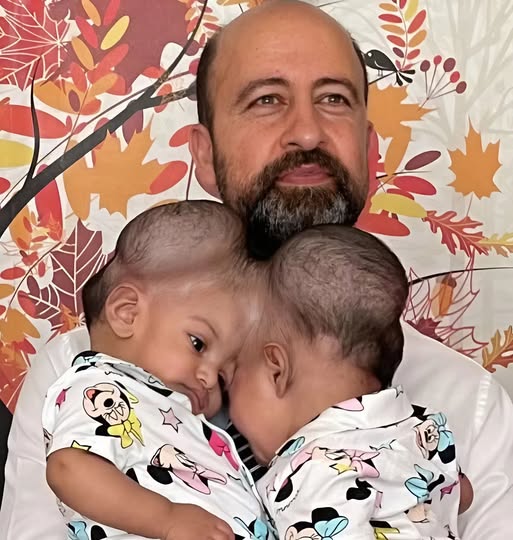
Manal and Mirhi’s story is nothing short of miraculous. Born in Pakistan with an extraordinarily rare condition known as craniopagus, the twin sisters came into the world joined at the head, sharing a portion of their skull and a complex network of blood vessels. Such births are exceedingly rare—occurring in roughly one in every 60,000 newborns—and only a handful of children survive long enough for doctors to even consider surgical separation.
From the moment they were born, the girls faced a precarious and uncertain future. Their parents lived each day with the heart-wrenching knowledge that their daughters’ lives were deeply intertwined—and that any attempt to separate them carried unimaginable risk. Yet, the hope of giving Manal and Mirhi independent lives never faded.
When the twins turned three years old, the family, in consultation with a team of experienced doctors, made a courageous and life-changing decision: they would attempt the separation surgery. To maximize their daughters’ chances, the family traveled to Bilkent City Hospital in Ankara, where a world-class international medical team took charge of the preparations and operation.
The preparation alone was an extraordinary feat. Using mixed reality technology, surgeons constructed detailed three-dimensional models of the twins’ skulls and brains, allowing them to meticulously plan every step of the operation. For months, they practiced the intricate procedure virtually, rehearsing how to carefully navigate the delicate vascular systems and shared cranial bone.
Finally, the day of surgery arrived. The complex operation was carried out in two stages, with the final stage lasting over 14 hours. Every move required extraordinary precision: the surgeons had to separate the twins’ meninges and vascular connections and then reconstruct the cranial bones so that each girl could have a complete and functional skull.
Despite the staggering risks, the surgery was a resounding success. Within days, both Manal and Mirhi were breathing on their own, responding to their surroundings, and showing signs of remarkable resilience. Their doctors report that the twins are recovering even faster than anticipated, and their rehabilitation continues as they gradually learn to sit, move, and explore their world independently.
For their parents, the transformation is nothing short of a miracle. For the very first time, they can hold each daughter separately in their arms, experiencing the joy and relief of seeing their children thrive as individuals.
Curious to see how Manal and Mirhi look today? Their inspiring post-surgery photos have been shared for the first time—check the first comment for a glimpse of their incredible journey from inseparable twins to two vibrant, independent children. 💖