For years, Christmas at my house wasn’t just a tradition—it was a given. No one ever asked if I wanted to host; it was simply understood that I would. My home was the biggest, my dining table the longest, my kitchen the most equipped. It made sense on paper. But in reality, what began as an act of love slowly turned into a quiet burden I didn’t know how to put down.
Every December, the cycle repeated. I’d drag boxes of decorations from the attic, rearrange furniture to make space for everyone, plan elaborate menus, and spend entire weekends shopping, chopping, cooking, and cleaning. I convinced myself it was worth it—the laughter, the clinking of glasses, the glow of lights reflecting off wrapping paper. I told myself this was what Christmas was supposed to look like.
But when the final guest left, and I stood in a kitchen piled high with dishes, something in me always sagged. My body ached, my wallet thinned, and my spirit felt oddly hollow. The next morning, when the house was finally quiet, I would wonder why the joy I’d worked so hard to create never quite reached me.
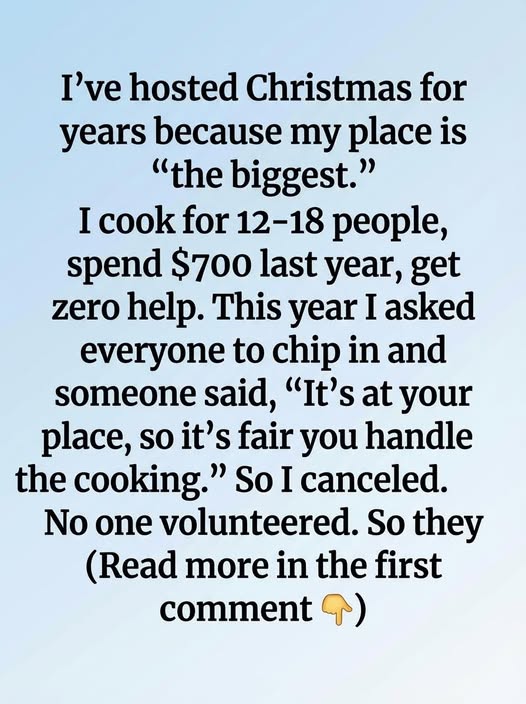
Last year, I hit my breaking point. I had spent hundreds of dollars and countless hours preparing everything alone. Not once did anyone offer to help in any meaningful way. No one chopped vegetables beside me, or washed a single pan without being asked. The most I heard was a casual, “You really outdid yourself again this year!”—as though exhaustion were something to be admired.
So when the holidays approached again, something inside me shifted. I didn’t feel bitter, exactly—just aware. Aware of how uneven it had all become. Aware that what was meant to be shared had quietly turned into a one-person production.
This time, I decided to speak up. I suggested that everyone contribute somehow—bring a dish, chip in for groceries, lend a hand in the kitchen. The room went awkwardly quiet. A few polite nods, a half-hearted joke. Then someone said, almost dismissively, “Well, since it’s at your house, it makes sense that you handle the cooking.”
That comment landed harder than I expected. It wasn’t cruel, but it revealed something deeper—that my effort had become invisible, taken for granted. In that moment, I realized I had created a tradition that didn’t honor me.
After sitting with that truth for a few days, I made a choice I never thought I would: I told everyone I wouldn’t be hosting Christmas this year.
I expected a flurry of messages, maybe even offers to take over. Instead, there was silence. The group chat went still. Days passed, and no one volunteered. No one suggested an alternative plan. Christmas, it seemed, would simply… not happen.
At first, the guilt hit hard. I imagined disappointed faces, quiet houses, traditions fading because I’d finally said “no.” But beneath that guilt, something else began to bloom—a strange, weightless relief.
When Christmas Day finally arrived, it felt unrecognizable in the best possible way. There was no chaos, no timer beeping from the oven, no endless to-do list taped to the fridge. Instead, there was peace. I made a simple meal just for myself, lit a candle, and watched the winter light fade through the window.
It was quiet—almost startlingly so. But in that stillness, I found clarity. The holiday didn’t need grandeur to have meaning. It didn’t need twelve guests and a dozen dishes. What it needed was honesty—about what I could give, what I couldn’t, and what I deserved in return.
That Christmas taught me something I wish I’d learned sooner: traditions should be built on shared care, not silent obligation. Saying no doesn’t destroy the spirit of the season—it protects it. Sometimes, the most loving thing you can do is step back and let go.
And when you do, you might just find that what remains—peace, quiet, and your own sense of worth—is the truest gift of all.