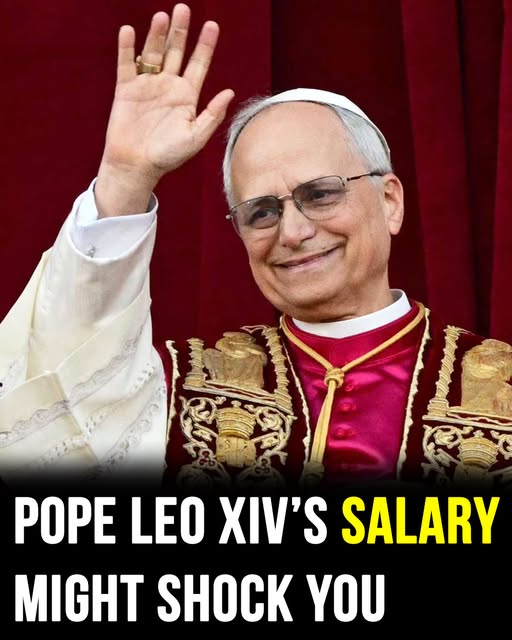
When the white smoke rose above the Vatican and the world learned that Robert Francis Prevost would become Pope Leo XIV — the first American pope in history — many people imagined a life of unimaginable luxury waiting behind the walls of Saint Peter’s Basilica. To the outside world, the papacy appears to be one of the most powerful positions on Earth: global influence, historic palaces, priceless treasures, private ceremonies, and millions of followers hanging on every word. Naturally, people assumed the role must come with an enormous salary and a lifestyle reserved for the elite.
But then came the revelation that stunned many across the globe.
Pope Leo XIV would not receive a traditional paycheck. No multimillion-dollar income. No personal empire. No fortune quietly accumulating behind closed Vatican doors. Instead, the man now leading more than a billion Catholics enters a life built not on ownership, but on surrender.
The Vatican will provide everything he needs — his residence, meals, transportation, healthcare, security, and travel — yet almost none of it truly belongs to him. On paper, the pope’s personal financial compensation is remarkably modest, closer to a symbolic stipend than the salary people imagine. The role grants access to immense institutional resources, but not personal wealth. In one of the greatest paradoxes of modern power, the pope may stand at the center of one of the world’s most influential institutions while personally owning very little.
And that contradiction is exactly the point.
The papacy was never designed to function like a throne of luxury. At its core, it is meant to symbolize sacrifice, humility, and service. Pope Leo XIV is expected to continue the example set by Pope Francis, who became widely known for rejecting extravagance and embracing simplicity. Francis famously chose modest living arrangements over lavish papal apartments, avoided displays of wealth, and consistently reminded the world that the Church’s mission is not about status — it is about compassion, mercy, and humanity.
Leo XIV now steps into that same spiritual philosophy.
The elegant vehicles, the centuries-old palaces, the priceless artwork, the global recognition, and the immense authority attached to the papacy are not intended for personal indulgence. They exist to support the mission of the Church and the responsibilities of a leader whose influence stretches across continents, cultures, and crises. Every appearance, every journey, every act of diplomacy carries the weight of spiritual leadership rather than personal ambition.
To many people, a life without ownership sounds restrictive. Yet within the Vatican, it represents a profound statement: the pope is not meant to accumulate riches, but to dedicate himself completely to service. His value is measured not by what he possesses, but by what he gives away — his time, his energy, his guidance, and his devotion to millions seeking hope and direction.
That is why the absence of a massive paycheck is not a hidden detail or a technical loophole. It is a deliberate reflection of what the role is supposed to mean. In an era obsessed with wealth, celebrity, and excess, the image of one of the world’s most powerful figures living without personal fortune feels almost unbelievable.
And perhaps that is what makes the story of Pope Leo XIV so compelling.
Behind the white robes and historic ceremonies stands not a billionaire ruler, but a servant carrying the spiritual expectations of an entire global faith. A man surrounded by grandeur, yet called to live with humility. A leader with access to extraordinary influence, yet reminded daily that the true purpose of his position is not power — but service.