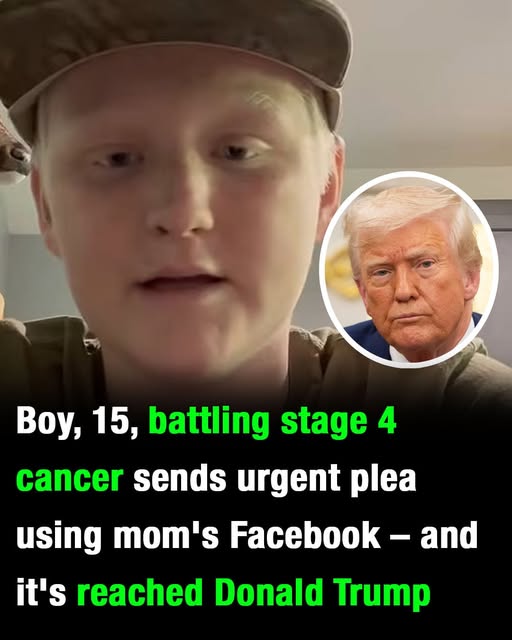
The video was never intended for the world’s eyes.
It began in silence—inside a dimly lit bedroom where a 15-year-old boy named Will Roberts lay exhausted, his body worn down by relentless bone cancer. After sixteen months of brutal chemotherapy sessions, hospital corridors, and whispered conversations he was never supposed to fully understand, Will had reached a point where hope felt fragile… almost imaginary.
But what he still had was a phone.
And in the absence of answers from medicine, he did something no one expected.
He secretly logged into his mother’s Facebook account.
There was no script. No media plan. No adult guidance. Just a teenager staring into a camera, fighting back fear with the only weapon he had left: his voice.
He wasn’t asking for attention.
He was asking for time.
“Please… I don’t want to die,” he said in his plea. Not as a performance, not as a statement—but as a raw, unfiltered truth from someone who should have been thinking about school, friends, and the future, not survival.
Then he pressed “post.”
Within hours, something extraordinary began to unfold.
The video spread quietly at first—shared by strangers who didn’t know Will, but couldn’t ignore him. Then it exploded. Tens of thousands became hundreds of thousands. Soon, millions of people across the world had watched a boy they had never met plead for his life in the most human way possible.
And then, the ripple reached places no one could have predicted.
The Oval Office took notice.
Messages were exchanged behind closed doors. Calls were made between families, doctors, aides, and officials. A story that began in a bedroom was now circulating at the highest levels of power. Even Donald Trump and Melania were drawn into the growing urgency, alongside lawmakers suddenly confronted with a child whose voice had cut through political noise and landed directly in the center of national attention.
At the heart of it all, though, was still Will.
A controversial treatment known as DeltaRex-G, offered at a clinic in California, emerged as a possible lifeline. It wasn’t guaranteed. It wasn’t widely approved. But for Will’s family, it represented something they had nearly lost: a chance.
A chance to fight back.
The cost—nearly $500,000—felt impossible for a family already drained emotionally, physically, and financially. Yet something remarkable happened in response to his video. Donations began pouring in from across the globe. Small contributions from strangers. Large gifts from people moved by a boy they would never meet. Messages of support flooded in, each one carrying the same quiet refusal to let his story end too soon.
Through it all, Will remained strangely steady.
Even as the world reacted to his fight, he rarely spoke about himself. Instead, he talked about others—about kids in hospital rooms like his, about families trapped in the same cycle of hope and fear, about a world where survival shouldn’t depend on viral videos or political attention.
In those moments, his story became something larger than illness.
It became a reflection of collective compassion—and collective failure.
Because for every door that briefly opened for Will, countless others remained shut for children just like him.
And yet, despite everything, he held onto a stubborn kind of hope. Not loud. Not dramatic. But persistent. The kind that survives even when the odds don’t.
Whatever comes next—whether the treatment works, whether time is enough—Will has already changed something irreversible in the people who heard him.
A reminder that behind every headline is a heartbeat.
And behind every desperate plea… is a child who simply wanted to live a little longer.