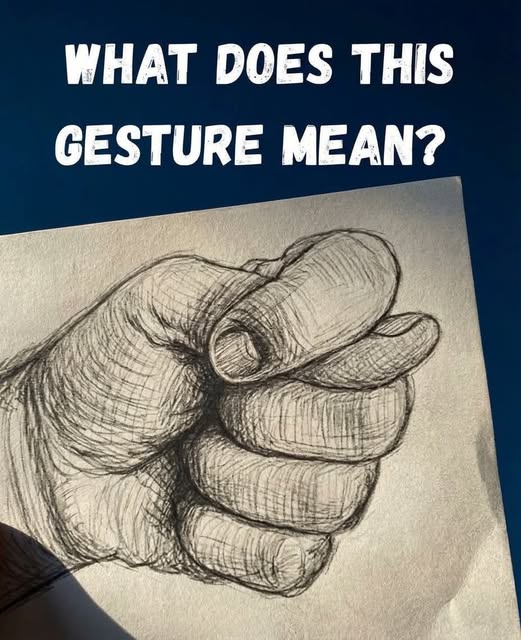
At first glance, it seems almost forgettable—just a small, closed hand, the thumb tucked discreetly between two fingers as if hiding from view. Nothing about it demands attention. And yet, beneath that modest exterior lies a gesture once charged with quiet intensity. It carried meanings too bold to be spoken aloud, too risky to declare openly. In its silence, it resisted. In its stillness, it protected. It was a secret language of defiance, disguised as something ordinary, passed from one hand to another like an unspoken understanding.
This simple configuration of fingers—what history remembers as the “fig gesture”—was never merely about anatomy. It was about intention. In times and places where voices had to be measured and words could spark conflict, this subtle sign became a refuge. It slipped into the margins of human interaction: behind polite smiles in rigid drawing rooms, within the bustle of crowded streets, or in the fragile pauses of farewell where emotions threatened to spill over. It allowed people to express what could not safely be said—to push back without provoking, to signal awareness without accusation, to claim a quiet kind of power in moments of restraint.
There was something almost subversive about its subtlety. It let a person say “no,” or “I won’t accept this,” without ever forming the words. It could challenge authority without open confrontation, preserve dignity without escalating tension. In a world governed by strict social codes and unspoken hierarchies, that mattered. The gesture became a shield—small, discreet, but deeply personal. It protected boundaries in environments where boundaries were rarely respected aloud.
And yet, like many things shaped by time, its meaning did not remain fixed. What once carried an edge of rebellion gradually softened, evolving into something warmer, more intimate. The same gesture that once signaled resistance began to appear in moments of affection and play. Grandparents used it in teasing, their eyes twinkling with mischief. Parents offered it to soothe nervous children, turning it into a symbol of comfort rather than defiance. Friends exchanged it in fleeting moments of humor, its original sharpness mellowed into something familiar and safe.
Even in partings, it found a place—those quiet, fleeting seconds before goodbye, when words feel inadequate and emotions hover just beneath the surface. There, the gesture lingered as a small, human connection: a way of saying “take care,” “remember,” or “I’m with you,” without needing to explain.
Today, many people may not recognize the fig gesture or consciously use it, yet its essence hasn’t disappeared. It lives on in the subtle ways we navigate the world—in how we set boundaries without cruelty, how we protect ourselves without hostility, how we communicate volumes through the smallest actions. It reminds us that not all strength needs to be loud, and not all resistance needs to be seen to be felt.
In the end, this quiet little gesture tells a larger story: that even the smallest movements can carry centuries of meaning, that silence can speak as powerfully as words, and that sometimes, the most profound expressions of who we are are the ones hidden in plain sight.