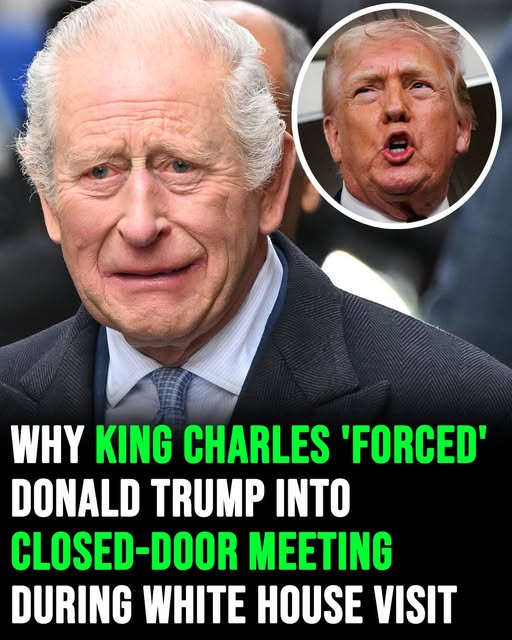
King Charles didn’t merely turn down the cameras—he effectively erased them from the moment.
For two tightly wound days in Washington, anticipation built across the globe. Commentators predicted fireworks: a rare, unscripted Oval Office clash between two figures who could not be more different in temperament or role. Yet when the moment came, the spectacle never materialized. There was no joint press conference, no carefully clipped quotes for headlines, no viral exchange to dissect. Instead, there was silence—thick, deliberate, and telling. What unfolded behind closed doors became a matter of speculation, a story pieced together only through fragments and whispers.
Beneath the polished optics of diplomacy—the measured smiles, the rehearsed handshakes—lay a deeper tension. King Charles arrived not as a political actor, but as a constitutional monarch carrying the full weight of centuries-old restraint. His position demands neutrality, an almost surgical avoidance of controversy, especially in matters as charged as Ukraine, NATO, or transatlantic alliances. Every word he speaks in public is expected to hover above politics, untouched by the friction of partisan debate.
Donald Trump, on the other hand, has long embraced that very friction. His political identity is built on spontaneity, confrontation, and moments that break protocol in favor of raw, unscripted impact. Where Charles must remain measured, Trump thrives on unpredictability—the very ingredient that can transform a formal state visit into a global media storm within seconds.
British officials understood the stakes with striking clarity. One unguarded comment, one unscripted exchange caught on a live microphone, could ripple far beyond the room—potentially entangling the monarchy in political controversy and reshaping public perception in ways that cannot easily be undone. The risk wasn’t just diplomatic; it was institutional.
So the decision was made, quietly but decisively. The traditional joint press conference—normally a centerpiece of such visits—was removed from the agenda. No cameras were allowed to frame the interaction. No live audio could capture an unintended remark. The meeting itself still took place, but it unfolded in a carefully controlled environment, shielded from the immediacy of global media.
In the end, what the world didn’t see may have mattered more than anything it could have watched. By shutting out the cameras, King Charles didn’t just avoid a moment—he prevented one from ever existing.