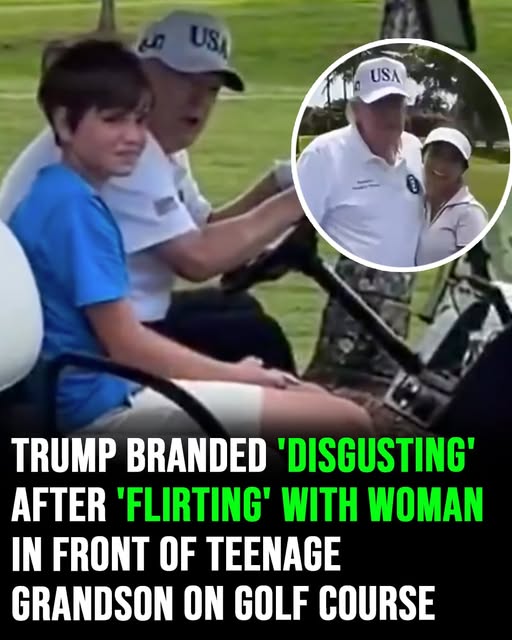
Donald Trump was back on the golf course at a moment when few expected to see him there—and certainly not under these circumstances. This wasn’t a quiet afternoon away from cameras or a routine outing among friends. Instead, it unfolded in a way that quickly captured global attention. A rare and widely circulated video appears to show him riding in a golf cart beside his young grandson, speaking loudly as he comments on a woman’s appearance before gesturing for her to come closer and pose for a photo. Within hours, the clip spread across social media, igniting a wave of reactions that ranged from disbelief to sharp condemnation, with critics calling the moment “disgusting,” “embarrassing,” and emblematic of deeper concerns about leadership during a time already strained by war, economic pressure, and cultural division.
The backlash didn’t emerge in isolation. For many observers, the video felt like the latest chapter in a long-running narrative surrounding Trump’s relationship with golf, privilege, and public conduct. Over the years, detractors have painted a picture of a leader who retreats to exclusive courses while national and global challenges intensify, and who has faced repeated allegations—sometimes from within his own circles—about bending the rules of the game. Stories of competitive shortcuts and a win-at-all-costs mentality have circulated widely, reinforcing a perception among critics that golf, for Trump, mirrors a broader approach to power.
Seen through that lens, the newly surfaced footage struck a nerve. To some, it wasn’t just an offhand remark caught on camera, but a moment that underscored what they view as a pattern of behavior—one that blurs the line between public responsibility and private indulgence. The presence of his grandson in the scene added another layer, prompting discussions about example, influence, and the values modeled in such moments.
Supporters, on the other hand, have largely brushed off the controversy, framing it as harmless, unscripted banter blown out of proportion in an era of constant surveillance and partisan scrutiny. But for critics, the clip has become something more symbolic: a snapshot that reinforces their belief that Trump has never fully grasped—or chosen to embody—the weight and expectations of the office he once held.