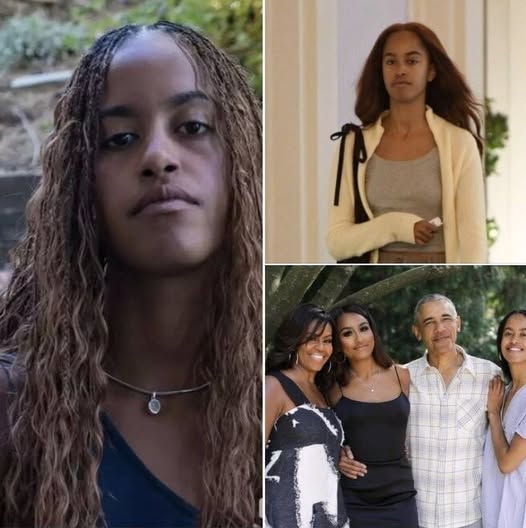
She made a decision that very few children of world leaders ever even consider, let alone act upon. A single name change. Quiet on the surface, almost unnoticeable to the casual observer. And yet, beneath that subtle shift lies something far more powerful: a deliberate step toward independence, identity, and artistic truth.
Malia Obama, daughter of one of the most recognized political figures in modern history, has entered Hollywood not by rejecting her past, but by redefining how she stands within it. In an industry where last names can open doors—or keep someone trapped inside expectations—they can also become labels that overshadow the individual. For Malia, stepping into the creative world under a different professional name is not about erasing where she comes from. It is about deciding, consciously and courageously, how she wants to be seen moving forward.
Now working professionally as Malia Ann, she has chosen to lean into her middle name, a subtle but meaningful shift that signals authorship over inheritance. It is less an act of rebellion and more an act of self-definition. Rather than asking the world to interpret her through the lens of political legacy, she is asking it to meet her in a different space entirely: the space of a writer, a creator, and a young woman still shaping her voice.
In doing so, she is gently reframing the narrative that has followed her since childhood. Growing up in the public eye meant growing up under constant interpretation—every stage of her life viewed through history, policy, and symbolism. But creative work demands something different. It demands distance from expectation, freedom from imposed meaning, and the courage to fail, experiment, and evolve without carrying an entire surname’s weight in every room.
Her emerging presence in Hollywood reflects that philosophy. From contributing in the writers’ room of Swarm, a project associated with Donald Glover, to developing her own creative ideas, she is gravitating toward stories that sit in uncomfortable but honest territory. Themes of identity, isolation, love, and the quiet strangeness of modern life echo through the kind of narratives she is drawn to—stories that ask difficult questions rather than provide easy answers.
There is a noticeable thread connecting her artistic interests to her personal evolution. Many of the stories she engages with explore what it means to become someone outside of expectation—what happens when identity is not assigned, but discovered. That mirrors her own journey in real time: a young woman born into one of the most documented families in the world, choosing instead to pursue the slower, more uncertain process of becoming herself on her own terms.
Of course, the Obama legacy will never disappear from her story. It is part of the cultural fabric around her name, part of how the world first learned who she was. But what makes this moment significant is not separation from that legacy—it is coexistence with it. Malia Ann is not stepping away from her history; she is stepping alongside it, refusing to let it be the only definition of her identity.
In an era where fame is often inherited, curated, or amplified by proximity, her choice carries a different kind of weight. It suggests that even those born into the most visible narratives still have the right to rewrite their own introduction. And in doing so, she quietly challenges a larger assumption: that identity must always be tied to what came before it.
What she is building now is not just a career, but a perspective—one that prioritizes authorship over association, and voice over visibility. And perhaps that is the most telling part of all: not the name she was given, but the one she chooses to use when she is finally speaking for herself.