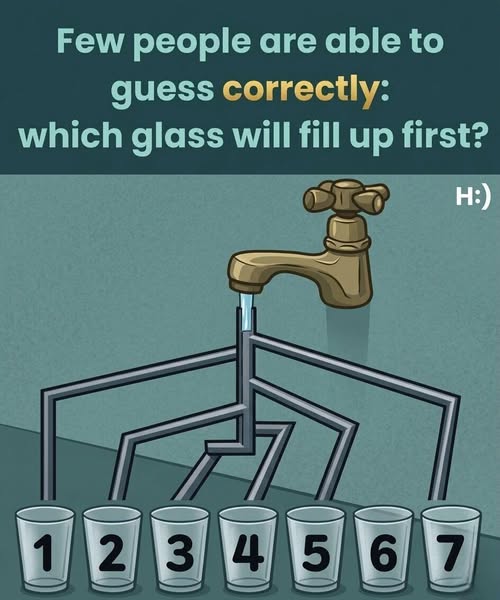
A single stream of water, seven waiting glasses lined up in silent anticipation, and a deceptively simple maze of pipes—on the surface, it looks like a straightforward flow puzzle. Your mind immediately begins doing what it always does: tracing paths, predicting outcomes, and deciding which glass will be filled first. It feels almost automatic, as if the answer is already there waiting to be confirmed.
But that is exactly where the trap begins.
Nothing in this image behaves the way your intuition expects. Every glance suggests order, direction, and continuity—yet every assumption quietly leads you astray. You imagine the water flowing cleanly through the system, splitting and reaching its destinations in a neat, satisfying resolution. Your brain rushes ahead, stitching together a story that the diagram only pretends to support.
And yet, as the illusion unravels pipe by pipe, a different reality starts to emerge.
The true brilliance of this puzzle lies not in the complexity of the pipes, but in the confidence with which your mind misinterprets them. Human perception is built for efficiency, not accuracy. We are pattern-finishers by nature—we fill gaps, smooth over inconsistencies, and assume continuity even when none is guaranteed. If something looks connected, we treat it as connected. If a path appears open, we mentally complete it without hesitation.
This diagram exploits that instinct with precision.
At first, everything seems plausible. A branching line here, a downward slope there, a curve that suggests motion. But the closer you examine it, the more the structure resists your assumptions. The connections are not what they seem. Some pipes that appear linked never actually meet. Others are deliberately blocked in ways that are easy to miss at first glance. Certain routes imitate flow so convincingly that your mind “accepts” them before verifying whether they truly function.
This is where the puzzle becomes unsettling.
It forces you to slow down—painfully, deliberately—and abandon the instinct to jump to conclusions. You begin checking each junction one by one. Every bend is reconsidered. Every split is questioned. What once felt like a flowing system now reveals itself as a carefully constructed illusion of flow, designed to exploit your trust in visual logic.
And as the inspection continues, the outcome becomes unavoidable.
Each possible path to the seven glasses collapses under scrutiny. One is blocked before it even begins. Another leads to a loop that never reaches a destination. Several appear promising but terminate abruptly, their endings disguised just enough to escape immediate notice. Slowly, methodically, every glass is ruled out.
In the end, the conclusion feels almost offensive to intuition: no glass is filled.
Yet it is undeniably correct.
What lingers after the answer is not the puzzle itself, but the realization it exposes. The system was never about water, pipes, or glasses. It was about perception—about how quickly the mind commits to stories it has not verified, how readily it accepts visual “truths” that crumble under closer inspection.
The real twist is not in the diagram.
It is in us.