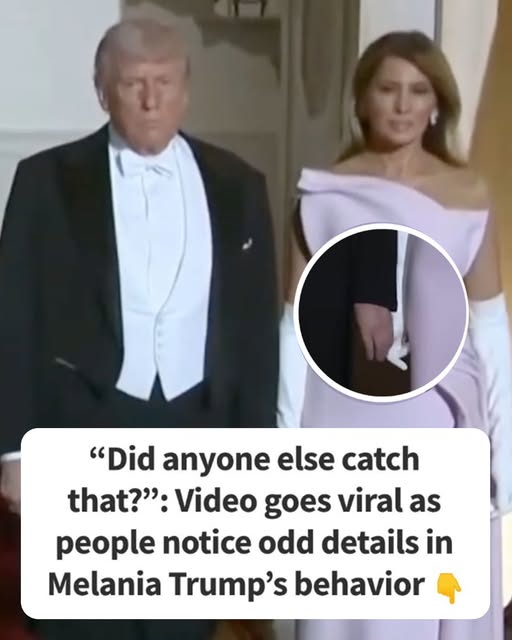
The cameras didn’t miss a thing.
In a grand, glittering state dinner meant to celebrate diplomacy at its highest level—where every smile is measured, every handshake rehearsed, and every glance carries diplomatic weight—one almost imperceptible gesture became the center of global attention. A small movement of Melania Trump’s hand. That was all it took.
Within hours, that fleeting moment was replayed endlessly across screens, slowed down, zoomed in, dissected frame by frame. Suddenly, the evening was no longer about King Charles III, Queen Camilla, or the carefully choreographed language of international relations. It wasn’t about formal toasts, polished speeches, or the symbolism of two nations sharing a ceremonial table. Instead, the internet fixed its gaze on something far smaller—and far more emotionally charged.
Was it rejection? Was it restraint? Was it simply protocol, the invisible choreography expected of someone in a highly formal public role? Or was it something more personal, something unspoken, slipping through in a fraction of a second that cameras happened to capture?
Viewers debated as though they were witnessing a revelation. Some insisted they saw distance between a wife and her husband, interpreting the gesture as emotional withdrawal. Others dismissed it entirely as overanalysis, arguing it was nothing more than the disciplined composure expected of a First Lady at a royal event, where posture, spacing, and restraint are part of the unspoken rulebook.
And somewhere between those competing interpretations lies a quieter, more complicated truth—one that the public rarely has access to. High-profile appearances like this exist in a world where image is carefully constructed, where etiquette often overrides instinct, and where personal emotion—if present at all—must pass through layers of scrutiny before it is ever expressed openly.
Melania Trump’s presence only intensified the fascination. Dressed in a refined, immaculate Dior ensemble, she evoked echoes of classic first-lady elegance—often compared to the composed glamour of Jacqueline Kennedy. That visual parallel sharpened everything: the posture, the distance, the stillness. It created an almost cinematic contrast between polished perfection and the public’s hunger to read meaning beneath it.
But what makes moments like this so powerful is not necessarily what happened—it’s what people believe might have happened. In a world where every second of footage can be paused and analyzed, perception often becomes more influential than reality. A gesture that lasted barely three seconds expands into hours of debate, think pieces, and speculation.
And in the end, perhaps that is the real story.
The viral “hand moment” says less about Melania Trump and Donald Trump, and even less about King Charles III or Queen Camilla, than it does about the audience watching. It reveals how easily we project narratives onto public figures—stories of tension, affection, distance, or control—based on fragments that may never have been meant to carry meaning at all.
That single, brief gesture became something larger: a mirror. It reflected our fascination with power, with image, with relationships lived under constant observation. It reflected our desire to find hidden truths in polished surfaces, to believe that every movement must mean something profound.
And perhaps most of all, it reminded us that in the age of constant recording, even silence and stillness are never just that—they are always interpreted, always debated, always turned into story.