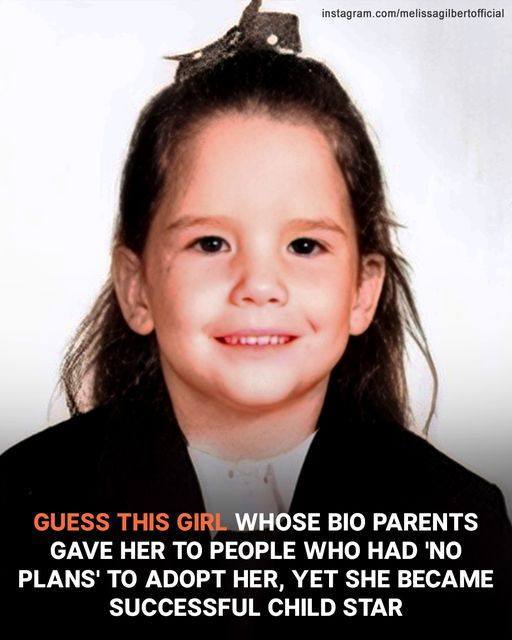
They told her she was chosen. That she was special. That she was wanted more than anything else in the world.
That was the first lie—softly spoken, neatly packaged, and accepted as truth because every child believes the story that explains their beginning.
The second lie would take decades to reveal itself.
It arrived much later in life, when everything that once felt solid had already been carefully built and publicly admired. It came wrapped in affection, history, and carefully edited memory. And then it shattered in a single moment—one word, casually spoken, almost thrown away—yet powerful enough to split her entire sense of identity in two. “It.” Not a name. Not a promise. Not a person. Just “it.”
For Melissa Gilbert, life did not begin with certainty or tenderness, but with negotiation. A baby passed from one set of hands to another like a decision being finalized rather than a life being welcomed. The narrative she was given was elegant, even glamorous: a brilliant Rhodes Scholar father, a poised and accomplished prima ballerina mother—two extraordinary lives supposedly too luminous, too consumed by greatness, to include a child. It was a story that made abandonment sound almost like destiny, as if she had been spared rather than left behind.
But reality, as it often does, refused to stay that polished.
The truth was far less cinematic and far more human: a young dancer and a struggling stock car racer, already overwhelmed by the weight of an existing family, already stretched thin by exhaustion and financial strain. Not mythic figures reaching for greatness, but ordinary people trying—and failing—to hold too much at once.
Still, it was the language around her origin that lingered the longest. A small, almost careless recollection from her adoptive mother would echo through her life like a persistent wound: “They told me, ‘go get it.’” Not “her.” Not “the baby.” Just “it.” One syllable that stripped away personhood without even trying. A word that reduced a life to an object being retrieved.
That single fragment of language followed her everywhere—quiet but unshakable. It sat behind the applause of auditions, the intimacy of relationships, the carefully lit moments in front of the camera. No matter how bright her career grew or how loved she appeared from the outside, something in her always remained alert, listening for the echo of that original reduction.
And then, years later, another truth surfaced—darker, more complicated, harder to reconcile with the version of family she had spent a lifetime building. It didn’t just challenge what she knew; it destabilized the entire foundation she had stood on emotionally. The people she had trusted as anchors in her story were suddenly part of its distortion.
That was the moment the question finally became unavoidable—not whispered in fear, but confronted in clarity: if the beginnings were built on distortion, then what, exactly, had she been living inside all along?
Not a simple story of abandonment and rescue. Not a clean arc of pain followed by healing.
But something far more jagged.
A life assembled from half-truths, affectionate illusions, and the slow, painful work of learning that sometimes the hardest thing to inherit is not a legacy—but the truth about where you came from.