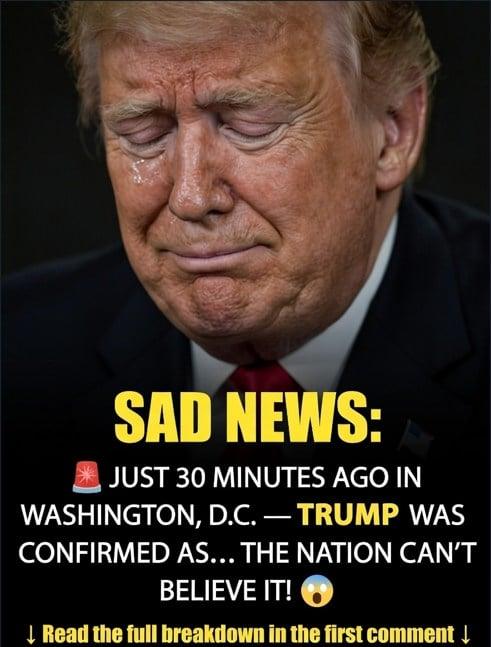
The room seemed to lose its air the instant Donald Trump began to speak. For years, Americans had grown accustomed to a very particular sound from him—confident, combative, almost theatrical in its certainty. But this time, something shifted. His voice caught in his throat, cracking in a way that felt jarringly unfamiliar. For a brief, suspended heartbeat, it was as if the entire country paused alongside him, caught in a moment no one had anticipated.
This was not the defiant showman many believed they understood. It was something far more complicated—raw, unsettling, and undeniably human. As he struggled to push forward, shaping words that few in the room expected to hear, a strange quiet spread through the crowd. It wasn’t the respectful silence of a political audience waiting for applause lines. It was heavier than that, filled with disbelief, unease, and a growing realization that something profound was unfolding in real time.
In that instant, the familiar script of modern politics seemed to fall apart. The bravado that had defined so many of his speeches—the cutting remarks, the rehearsed rhythms, the confident swagger—suddenly felt distant and irrelevant. None of it could protect him from the weight of the moment he was trying to confront. When his voice trembled again, the audience wasn’t merely watching a political figure address a crowd. They were witnessing a man grappling publicly with the gravity of his own narrative, a story that had become deeply entangled with the identity of the nation itself.
Faces in the room reflected a range of emotions that rarely coexist in political arenas. Some supporters leaned forward with visible empathy, interpreting the vulnerability as a sign of courage. Others looked uncertain, almost stunned, as if unsure how to process a version of the figure they had long seen as unshakeable. And among critics—many of whom had spent years opposing him—there was an unexpected pause. Even those who remained skeptical could not ignore the moment’s emotional intensity.
Beyond the walls of the room, the ripple spread instantly. In living rooms illuminated by television screens, in crowded bars where political debates often erupt, and on the endless scroll of phones across the country, people watched and reacted in real time. Social media feeds filled with clips, commentary, and speculation. For supporters, the speech quickly became a symbol of resilience and personal struggle. They spoke about loyalty, about standing closer than ever during what they saw as a defining test.
Critics responded differently but with a similar sense of gravity. While many remained deeply critical of his past decisions and rhetoric, some acknowledged that the vulnerability on display was impossible to dismiss entirely. It was a moment that complicated the usual narratives, blurring the sharp lines that often divide political perception.
As the speech continued, the tone shifted from personal strain toward a broader appeal. Trump called for resilience, invoking the idea that nations, like individuals, must endure moments of uncertainty and upheaval. When he spoke of unity, the words did not carry the triumphant energy of a campaign rally. Instead, they sounded reflective, almost weary—less like a battle cry and more like a recognition that the country itself was standing at a difficult crossroads.
By the time he finished, the applause that followed felt subdued, almost contemplative. The crowd rose, but the energy in the room remained complex—part admiration, part doubt, part quiet contemplation about what had just been witnessed. It was not the explosive reaction typical of political theater. It was something stranger: the sound of people processing a moment that didn’t fit easily into the categories they were used to.
History will eventually decide how to interpret that speech—whether it was a rare glimpse of authenticity, a carefully calculated pivot, or some mixture of both. Political moments often take years, even decades, to reveal their true meaning. Yet for those who watched it unfold, one thing was unmistakable.
A threshold had been crossed.
The familiar rhythms of American politics, so often loud and predictable, had briefly given way to something quieter but more unsettling. And in that silence, lingering long after the final words were spoken, there was a shared understanding that whatever came next would not simply return to what had existed before. The country had felt the crack in the voice—and with it, the uneasy realization that the story moving forward might be very different from the one it had known.