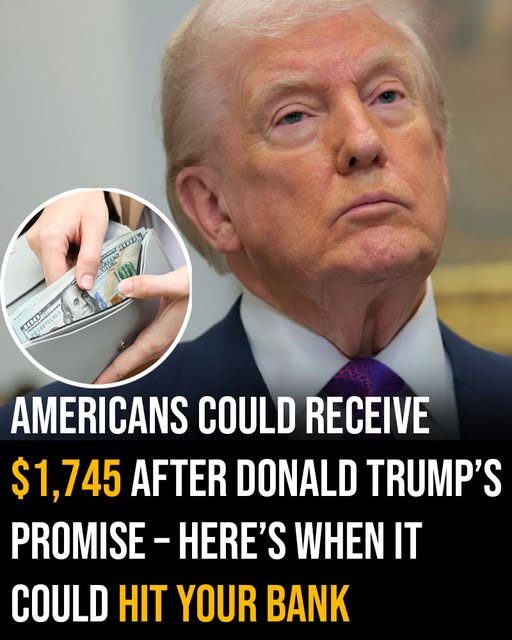
For months, a number has been circulating across news reports, social media posts, and dinner-table conversations: $1,745. Many Americans have begun wondering whether that amount could soon appear in their bank accounts as some kind of government payment. The possibility has sparked curiosity, hope, and plenty of confusion. Yet despite the buzz, the reality remains uncertain. The idea of such a payout exists more in political discussion and economic debate than in any finalized government policy.
At the center of the conversation is former president Donald Trump and his long-running push to reshape the way tariffs affect the American economy. Over the past several months, Trump has repeatedly argued that tariffs — taxes placed on imported goods — could ultimately benefit ordinary Americans if the money collected from those tariffs were redirected back to the public. According to his vision, Americans who bear the burden of higher prices caused by tariffs could eventually receive a direct payment as compensation.
In earlier discussions, the concept was framed as something similar to a dividend, echoing the stimulus-style payments that became familiar during recent economic crises. Trump had even referenced the possibility of checks around $2,000, suggesting that tariff revenue could be redistributed directly to American households. The pitch was simple and politically powerful: if tariffs generate billions of dollars, why shouldn’t the people who pay higher prices see some of that money returned to them?
Under that initial idea, funds collected from tariffs would essentially be pooled and then redistributed to citizens in the form of government checks. Supporters argued it could function almost like a national rebate — a way of giving Americans their share of the revenue generated through trade policies.
But that early vision ran into a significant legal and constitutional roadblock.
The Supreme Court of the United States stepped in and effectively blocked the straightforward approach of using tariff revenue to finance direct payments. The ruling didn’t eliminate the broader discussion about compensating Americans, but it did force policymakers to rethink how such a payment might actually work. The court’s decision reshaped the proposal entirely, pushing it away from a dividend funded directly by tariffs.
Now, instead of a dividend, the idea circulating in Washington looks more like a refund — a reimbursement for the extra costs Americans may have paid because of tariffs.
According to estimates from the Joint Economic Committee Democrats, American consumers absorbed roughly $231 billion in tariff-related costs between February 2025 and January 2026. When economists break that enormous figure down across households, it comes out to roughly $1,745 per family. That number is what sparked the widespread speculation about a potential payment of the same amount.
The argument behind the proposal is straightforward: if tariffs effectively caused consumers to pay more for everyday goods — from electronics to household products — then Americans should be reimbursed for the added burden those policies created.
Trump himself has hinted that, if such payments were ever approved, they might be targeted rather than universal. At one point he suggested the checks could focus on Americans earning less than $100,000 per year, directing the relief toward middle- and lower-income households. In October 2025 he publicly floated the idea of a dividend-style payment, and the following month he reiterated on his Truth Social platform that discussions about returning tariff-related funds to the public were ongoing.
Still, despite the headlines and speculation, no official program has been finalized.
There is currently no approved legislation, no confirmed payment schedule, and no guarantee that Americans will ever see a check tied to tariff costs. Even the widely discussed timeline — which Trump has suggested could begin sometime around mid-2026 — remains highly speculative.
Ultimately, the fate of any potential payout will depend on further legal clarification and political decisions, including possible guidance or rulings from the Supreme Court of the United States. Until those issues are resolved, the idea of a $1,745 payment remains exactly that: an idea still moving through the uncertain intersection of economics, law, and politics.
For now, Americans are left watching the debate unfold, wondering whether the much-talked-about refund will eventually become reality — or remain just another proposal that never quite makes it from political promise to money in their pockets.