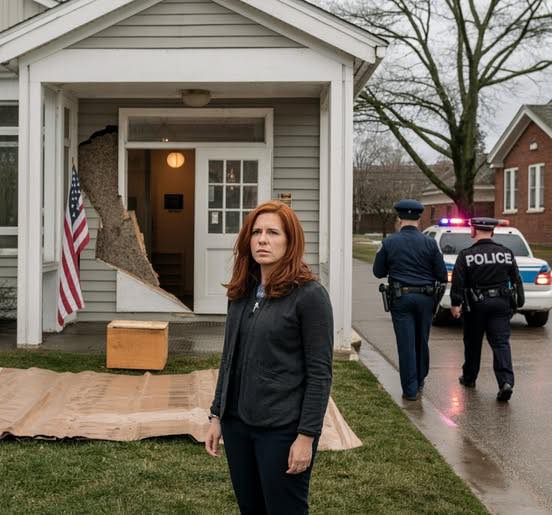
The lock didn’t just break—it surrendered like it had been waiting for this moment for years. One sharp snap of rusted metal, and the life I thought I knew collapsed inward. The childhood house didn’t feel like a home anymore; it felt like a sealed crime scene finally forced open, exhaling secrets that had been suffocating in the walls for decades.
Dust drifted through the air like ash from something long burned but never spoken of. Behind a false panel—hidden so precisely it felt intentional rather than concealed—my grandmother’s truth waited. A steel box, cold and deliberate, embedded into the structure as if the house itself had been trained to protect it. And on its surface: my initials. Not written, not scratched—carved. Deep, sharp, unmistakable. Like a warning meant only for me. Or a promise I was never meant to understand until it was already too late.
It didn’t feel like discovery. It felt like inheritance in its rawest, most unsettling form.
Every nail in that house suddenly felt suspicious. Every board seemed arranged with purpose. Even the silence carried weight, as if the walls had been rehearsing for this exposure long before I was ready to hear it. My grandmother’s rage wasn’t loud or chaotic—it was architectural. It lived in reinforcements, in hidden compartments, in decisions disguised as domestic routine. She hadn’t just lived in that house. She had engineered it.
And she had been waiting.
By the time the courtroom doors closed behind me, the air inside felt tighter than the hidden room ever had. The judge’s voice cut through the tension with practiced authority, but it barely mattered anymore. What mattered was what had already been dragged into the light: a forged will crafted with careful handwriting, claims of fabricated incompetence delivered with rehearsed sympathy, and testimonies from my parents so polished they sounded rehearsed rather than remembered.
Each lie didn’t just fall apart—it was dismantled, piece by piece, by evidence my grandmother had prepared long before her final breath. As if she had known exactly how the story would be rewritten without her, and refused to let it stay that way.
My sister spoke only once.
Her voice trembled—not with uncertainty, but with the weight of choosing truth over inheritance, truth over silence, truth over the fragile comfort of family mythology. She didn’t look at the floor. She didn’t look at them. And she didn’t look away from me. In that single act, something in the room shifted—not loudly, not dramatically, but permanently.
Even the verdict wasn’t what stunned me.
It was the silence that followed.
A heavy, suspended quiet—as if the entire courtroom had run out of language for what had just been uncovered. As if the story my family had rehearsed for decades had finally reached its final page and discovered there were no more lines left to read.
Later, I understood something I hadn’t been ready to see before: the inheritance was never really about property.
It was about permission.
Permission to rebuild what had been left to rot. Permission to restore the Ridgefield house not as it was, but as it should have been. Permission to carve my grandmother’s name into the entrance of a community center where her memory could exist in daylight instead of hidden compartments and sealed walls. Permission to let Marcus stay somewhere he could finally breathe without fear, without flinching, without waiting for the next fracture in the world around him.
And permission—most painfully—to accept that what I had always called love had arrived in the form of documents, coded warnings, a bracelet left too carefully, a plan laid out like a war strategy rather than a will.
She hadn’t trusted the law. She hadn’t trusted blood. She had trusted me.
Standing once again in the doorway of that house—the same threshold where everything had broken open—I felt the keys warm in my palm like something alive. The structure around me no longer felt like a ruin. It felt like a verdict that had been waiting years to be understood.
And in that moment, I finally saw it clearly:
The box hidden in the wall hadn’t destroyed my family.
It had simply stripped away everything that didn’t deserve to survive.